Lille’s industrial past didn’t disappear.
It learned how to serve beer.
Across Lille and its surrounding towns, enormous factories, textile warehouses and industrial halls that once employed thousands of workers are finding completely new lives.
Some have become craft breweries. Others now contain food halls, restaurants, urban farms, concert venues, rooftop terraces and places where locals meet for a drink after work.
And if you want to understand Lille beyond the Grand Place and Vieux-Lille, these places are worth seeking out.
This isn’t industrial heritage preserved behind a museum rope. You can sit inside it, eat in it, drink a locally brewed beer in it and sometimes dance in it until late.
Here’s where to discover some of the best examples.
Fives Cail: from locomotives to local beer
If I had to choose just one place to understand how Lille is reinventing its industrial past, I’d start at Fives Cail.
Don’t expect another picturesque Flemish square.
This place is huge.
The former Fives-Lille Cail factory was once one of the major industrial sites in northern France. Founded in the 19th century, it produced locomotives, industrial machinery, metal bridges and equipment for the sugar industry.
Thousands of people worked here.
The factory became so important that housing, shops and schools developed around it, helping shape the Fives neighbourhood itself.
When industrial activity finally ended in 2001, it left behind around 25 hectares of industrial land.
Rather than demolishing everything and pretending that history had never happened, Lille began transforming the site while retaining its enormous halls, steel structures and industrial identity.
Today, Fives Cail is becoming an entire new neighbourhood.
And this is where things get interesting for visitors.
Have a beer where locomotives were once built
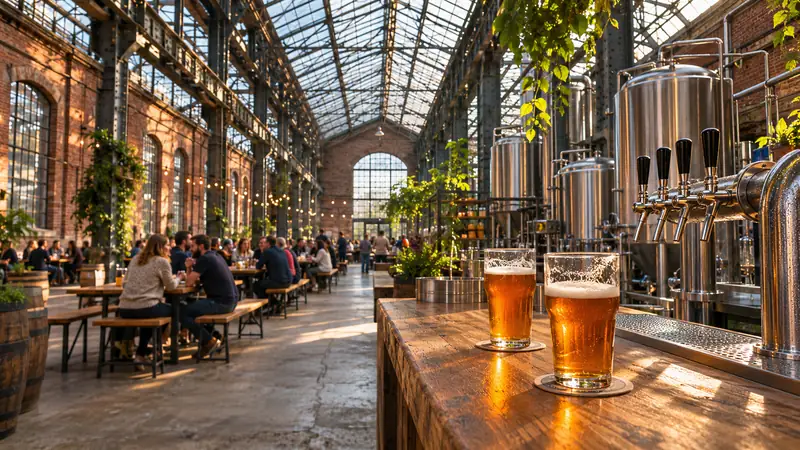
Walk beneath the enormous industrial structures and you’ll eventually find Brasserie Fives Cail.
It’s an independent microbrewery and taproom installed directly inside the former factory halls.
The beer is brewed on site, so the stainless-steel brewing tanks sit only a few metres from your glass.
There are 16 taps, including several permanent beers whose names reference the site’s industrial history.
You might order La Locomotive, a Belgian-style ale, or L’Ascenseur, a farmhouse ale.
It’s a small detail, but I like it.
The factory hasn’t been stripped of its identity and turned into an anonymous fashionable bar. The beer itself continues telling the story of the place.
There’s food, a large terrace and regular events too.
Come for: locally brewed beer in one of Lille’s most impressive industrial settings.
Then walk over to Chaud Bouillon
Don’t leave Fives Cail after one beer.
A few steps away you’ll find Chaud Bouillon, and this is where the scale of the transformation really becomes obvious.
Chaud Bouillon isn’t simply a food court.
Its central hall is part restaurant, part bar, part neighbourhood meeting place and part cultural venue, installed beneath the immense structure of the former factory.
There are several food counters, a bar, a stage and large communal spaces. Depending on when you visit, you might find a concert, DJ set, market, workshop or special event taking place alongside dinner.
But the public food hall is only one part of the project.
Chaud Bouillon also includes a community kitchen where residents can cook and learn together, a professional kitchen supporting food entrepreneurs and an urban farm.
That’s what makes Fives Cail much more interesting than a developer simply putting restaurants into an old warehouse.
People actually use the place.
Children play beneath the old industrial structures. Locals meet for a drink. Food businesses are being developed here. Community cooking classes take place next door.
It feels like a neighbourhood being built inside the skeleton of an old factory.
If food is one of the ways you like discovering a city, I’ve written more about places like Chaud Bouillon in my guide to street food in Lille.
Why I think Fives Cail is worth the detour
Fives isn’t where most British visitors automatically go.
That’s precisely why I’d recommend it.
You can spend the morning admiring 17th-century Flemish architecture around the Grand Place and, a few metro stops later, be drinking a beer underneath the steel framework of one of northern France’s great industrial sites.
Those two versions of Lille belong to the same city.
Take Metro Line 1 to Marbrerie and walk from there.
I’d go in the late afternoon, wander around the site while there’s still daylight, have something to eat at Chaud Bouillon and finish with a beer at Brasserie Fives Cail.
Gare Saint Sauveur: a station that never saw a passenger
Before heading out of central Lille, there’s one more place I’d add to the list, and it’s only a short walk from the town hall.
Gare Saint Sauveur opened in 1865 as a goods station. No passengers ever boarded a train here: it handled the freight that kept the city’s industries running. It mattered enough for Napoleon III and Empress Eugénie to arrive here on an official visit in 1867.
The station closed in 2003. Six years later, in March 2009, the City of Lille reopened part of it as a cultural venue for Europe XXL, the second lille3000 season. It has been one of the city’s most relaxed places to spend an afternoon ever since.
Hall B, around 5,000 m², hosts exhibitions that are often free to enter. There’s a cinema, and the programme fills up with concerts, DJ sets and family events, especially in summer. And in Halle A, the oldest building on the site, you’ll find Le Bistrot de St So, a bar-restaurant under the original iron roof frame, with brick walls and a cobbled floor. It reopened under new management in December 2025, much to the relief of everyone who lives nearby.
The rest of the old freight yard sat empty for two decades. In June 2026, it finally opened as Parc Saint-Sauveur: nearly five hectares of lawns, footpaths and play areas, zip lines included, where trains once unloaded.
It’s the same story as Fives Cail, just closer to the centre. The programme changes with the seasons, so check what’s on before you go.
Take Metro Line 2 to Mairie de Lille and walk from there.
Come for: a free exhibition, then a drink in a 19th-century goods hall.
Saint-André: an old textile site where Lille goes out
For another version of the same story, head north-west out of central Lille to Saint-André-lez-Lille.
Here, the old Halles de la Filature have become somewhere you can easily spend an entire evening.
Two particularly lively venues sit almost side by side: La Friche and Brique Land.
La Friche: street food, cocktails and a guinguette in an old factory
La Friche does exactly what its name suggests.
It’s installed in a former textile factory dating from the 1960s and has deliberately kept the atmosphere of an industrial space rather than disguising it.
Inside, you’ll find a large food-court-style space with independent street-food counters and two bars.
Outside, there’s a large guinguette-style area.
The atmosphere changes depending on when you visit. One evening might involve cocktails and dinner; another live music or a DJ set. In winter, the venue leans into a completely different atmosphere with raclette and even old cable-car cabins used as private dining spaces.
It’s also surprisingly family-friendly.
There’s an outdoor children’s play area, so Sunday lunch here is very different from Friday night at 11pm.
That’s another thing I like about these converted industrial spaces: they’re not necessarily nightclubs or bars. They’re becoming genuine places to live and meet.
Come for: a relaxed evening with a group when everyone wants to eat something different.
Walk next door to Brique Land
You could easily make a night of this area without going anywhere else.
Right next to La Friche is Brique Land, the Saint-André home of local craft brewery Brique House.
Again, you’re inside a former industrial site rather than central Lille.
The concept is somewhere between a brewery taproom, restaurant and enormous neighbourhood hangout.
Beer is the obvious reason to come – Brique House is a Lille-born craft brewery – but there’s also a strong Italian influence in the kitchen, particularly Neapolitan-style pizzas.
The huge covered and heated garden is particularly useful in northern France, where designing an outdoor venue on the assumption that it won’t rain would be optimistic.
There’s even Sunday brunch.
Come for: craft beer, pizza and one of the largest terrace-style spaces around Lille.
La Friche or Brique Land?
Why choose?
They’re virtually neighbours.
If you’re coming from central Lille specifically to discover this part of Saint-André, I’d make an evening of it.
Start with a drink at one, eat at the other and see which atmosphere you prefer.
This is not the Lille of polished restaurant terraces around Place du Théâtre.
And that’s the point.
If you’d rather stay in the historic centre, you’ll find plenty of alternatives in my guide to the best terraces in Lille. But if you’ve already done Vieux-Lille, Saint-André offers something completely different.
Roubaix: where industrial heritage gets even bigger
To really understand why there are so many enormous industrial buildings around Lille, you need to go to Roubaix.
During the height of the textile industry, Roubaix was one of Europe’s great manufacturing cities.
Factories, warehouses and textile buildings dominated entire neighbourhoods.
When that industry declined, it left an extraordinary architectural legacy – and an enormous challenge: what do you do with buildings designed for an industry that no longer exists?
One of the most interesting answers is La Condition Publique.
La Condition Publique: a textile building turned creative playground
Built at the beginning of the 20th century, La Condition Publique was created to store, inspect and certify textile materials including wool, cotton and silk.
It’s enormous: around 10,000 m².
Rather than functioning like a conventional museum today, it has become a creative and cultural hub.
There are exhibitions, concerts, performances, workshops, makers’ spaces and events.
But one of my favourite parts is above your head.
Go up onto the roof
The rooftops of La Condition Publique are accessible to visitors during the venue’s opening periods and are particularly pleasant on summer evenings.
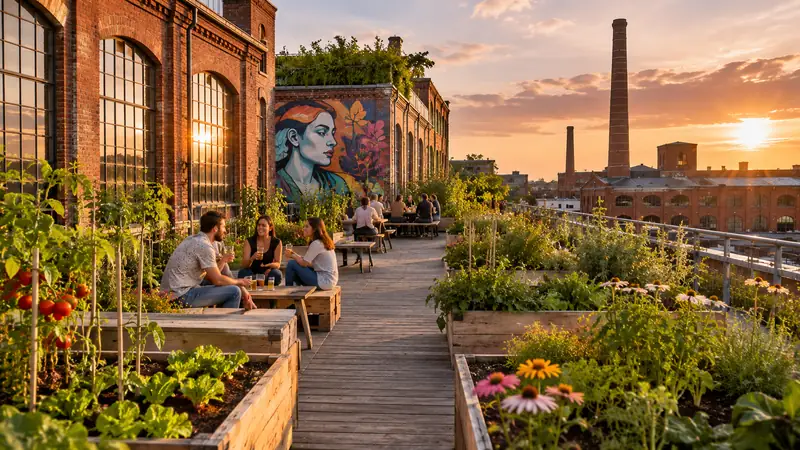
They’ve hosted some fairly unexpected things over the years: urban gardens, beehives, street art, camping and silent parties.
There are murals and artworks across the site, and from above you get a completely different perspective on Roubaix’s industrial landscape.
It also helps you understand just how enormous the old textile city was.
Factory chimneys and huge brick buildings aren’t isolated curiosities here. They’re part of the cityscape.
The bar at La Condition Publique opens on selected days and during concerts and events, so check the programme before travelling rather than assuming every evening works the same way.
If you’re making the journey to Roubaix, combine it with La Piscine and some of the other places in my guide to the best things to see in and around Lille.
These aren’t museums – and that’s what makes them interesting
You can visit museums dedicated to Lille and Roubaix’s industrial history, and some are excellent.
But these places offer something different.
At Fives Cail, you can drink a beer brewed metres from where locomotives were once manufactured.
At Chaud Bouillon, an industrial hall has become a food hall, community kitchen and urban farm.
At Gare Saint Sauveur, an old goods station hosts exhibitions, films and concerts, with a park where the freight yard used to be.
At Saint-André, a former textile site fills with people eating pizza, drinking craft beer and listening to DJs.
At La Condition Publique, a building created to control wool and cotton now hosts contemporary artists, concerts and rooftop events.
The architecture isn’t frozen.
It’s being used again.
Can you visit them all in one day?
You could.
I wouldn’t.
These aren’t really attractions to tick off a list.
They’re places to spend time.
If you only have a weekend in Lille, I’d choose Fives Cail for one late afternoon and evening. It’s easy to reach from central Lille by Metro Line 1 and gives you the strongest combination of industrial architecture, food and local beer.
If you’ve visited Lille before, spend another evening around La Friche and Brique Land in Saint-André.
And give Roubaix at least half a day. Combine La Condition Publique with La Piscine rather than travelling there just for one building.
From industrial Lille to the city locals use today
When people think about Lille, they tend to picture two things.
The beautiful Flemish façades around Grand Place and the cobbled streets of Vieux-Lille.
They’re not wrong.
But that’s only one part of the city.
The Lille metropolitan area was built just as much by factories, textile mills, railway lines, breweries and working-class neighbourhoods.
What I find interesting today is that many of those places aren’t being erased.
They’re changing purpose.
The factory becomes the brewery. The warehouse becomes the food hall. The textile inspection centre becomes the concert venue. The industrial courtyard becomes somewhere to meet friends on a summer evening.
And unlike many historic attractions, these aren’t places created primarily for tourists.
They’re places people who live here actually use.
That’s why, if you’ve already explored the centre, I’d recommend leaving Grand Place behind for an evening and seeing this side of Lille instead.
For more ideas beyond the obvious sights, continue with my guide to Lille off the beaten track, where you’ll find unusual architecture, cooking classes, creative spaces and more reasons to explore beyond the city centre.

Andy is a British editor, entrepreneur and travel media specialist who now calls the Lille area home. Formerly editor of Cycling Weekly and Procycling, he’s spent his career shaping content for the likes of World Travel Market, the Coach Tourism Association, the CRT Hauts-de-France and the Museum of the Great War, among others — and picked up three UK Editor of the Year awards along the way.
What sets Andy apart is a sharp instinct for UK media and PR, native-speaker writing, and an editorial eye built entirely around tourism. He knows exactly how to put the right words in front of the right British readers to make a destination land.
On Tour de Lille, Andy brings the expat’s perspective — an outsider who fell for the city and knows precisely what will make fellow Brits fall for it too.