Lille landmarks
Grand Place in Lille: how to read the square every Lillois walks through
Officially Place du Général de Gaulle. Nobody calls it that.
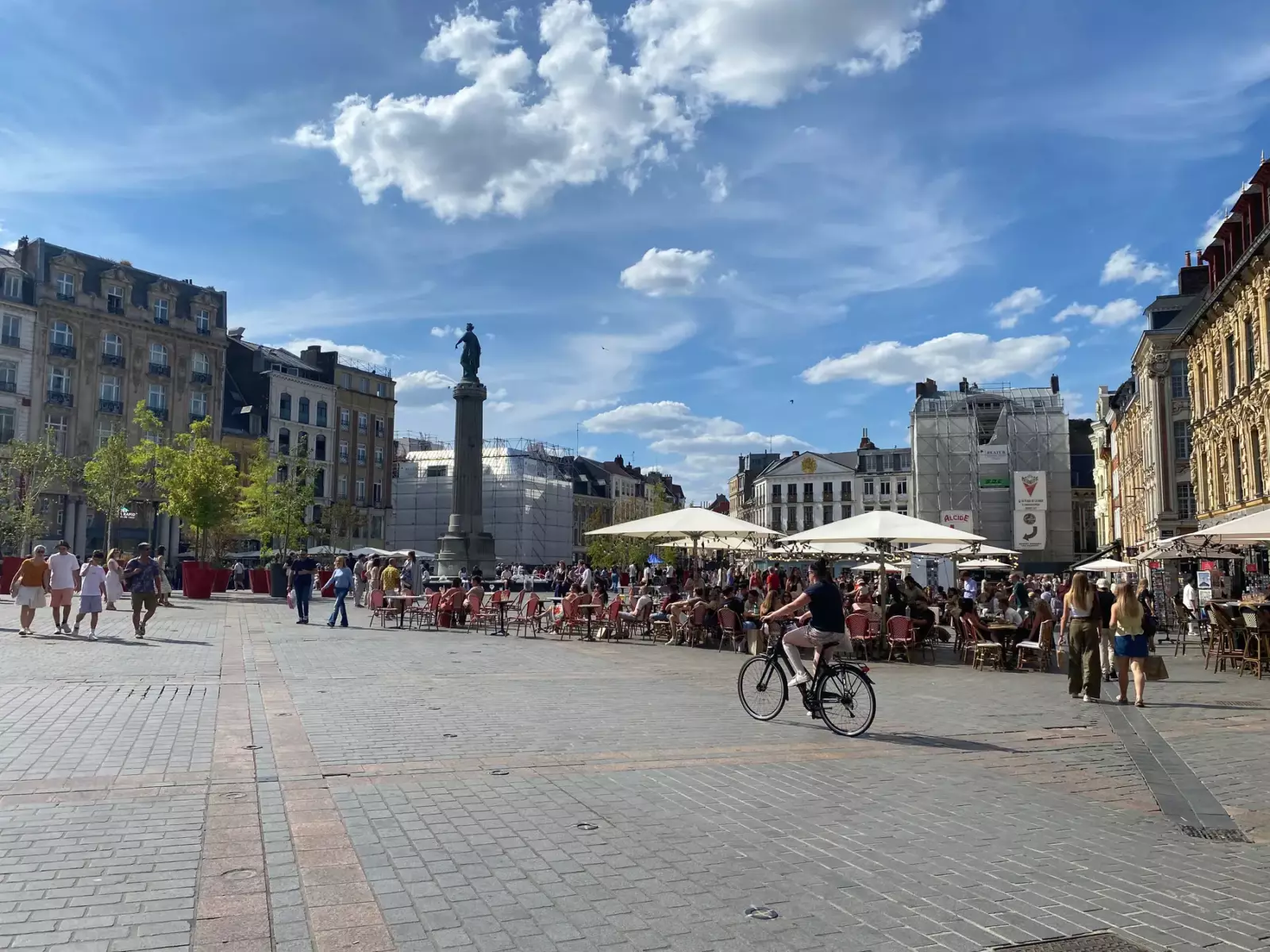
In short: the Grand Place is Lille’s main square, officially named Place du Général de Gaulle since 1944. In its centre stands the Column of the Goddess, raised in 1845 to honour the city’s resistance to the Austrian siege of 1792. Around it stand the Vieille Bourse, the Théâtre du Nord and the Voix du Nord building.
Every visit to Lille passes through the Grand Place, usually several times a day. It is where locals arrange to meet, where the Christmas big wheel turns and where the Braderie crowds are at their thickest. Most visitors photograph it and move on. Give it fifteen minutes with this page and the square starts telling you the history of the city.
From grain market to Place du Général de Gaulle
The Grand Place began as marshland. In the 14th century the ground was drained to host the grain market, and for centuries the square was built purely for trade, feeding the town and its merchants.
- 14th century: the drained marsh becomes Lille’s grain market.
- 1652 to 1653: the Vieille Bourse goes up in the middle of the market and splits it in two: the Grand’Place and the Petite Place, today’s Place du Théâtre.
- 1845: the Column of the Goddess is unveiled in the centre.
- 1936: the Grand Écho du Nord newspaper moves into its new building on the square.
- 1944: the square is renamed Place du Général de Gaulle, after the Lille-born general.
The official name never really caught on in conversation. Lillois still say “Grand’Place”, and some older residents call it Place de la Déesse, after the statue. If a local tells you to meet “at the Déesse”, you now know where to go.
Why it feels Flemish
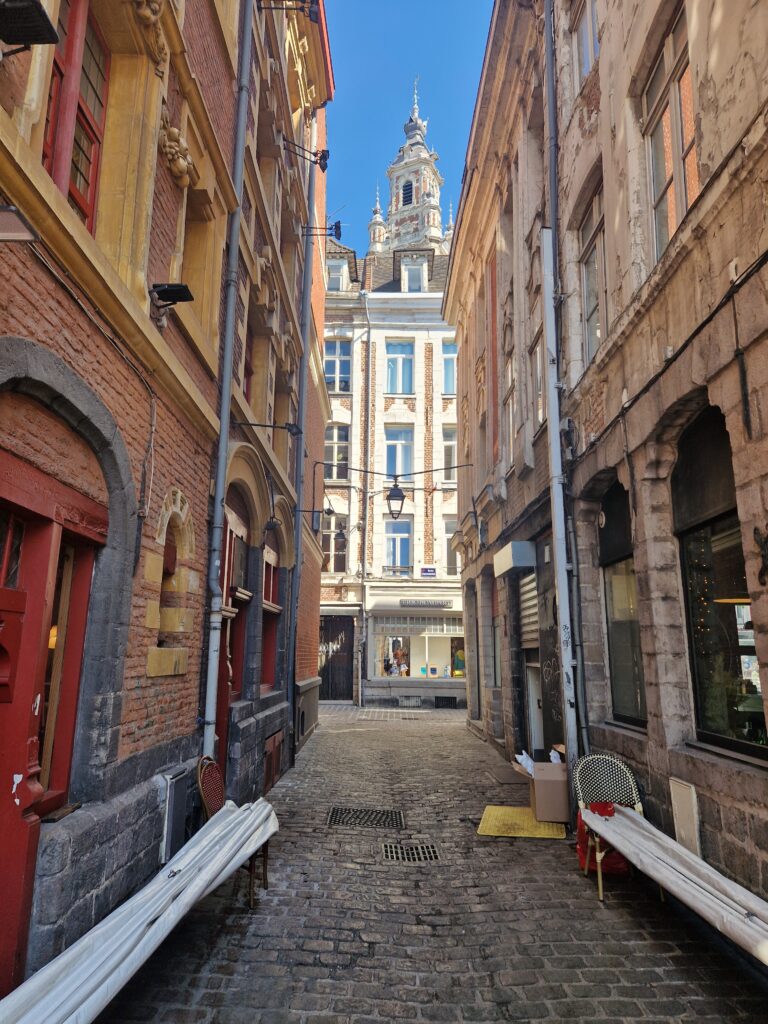
Lille was a Flemish town, then Burgundian and Spanish, before Louis XIV took it in 1667. The gables, the brick and the carved stone around the square show that mixed past more clearly than any museum.
Why it feels busy
Lille Flandres station is a few hundred metres away, so the Grand Place is the first open space most visitors cross. Add the pedestrian shopping streets on three sides and it rarely empties before midnight.
The Goddess and her firelighter
The column in the middle is the Memorial of the Siege of 1792. In the autumn of that year an Austrian army bombarded Lille, and the town refused to surrender. Half a century later, the city raised a monument to that stubbornness.
- Unveiled: 1845.
- Statue: by Théophile Bra, a sculptor from Douai.
- Column: designed by the architect Charles Benvignat.
- Nickname: the Goddess, used by Lillois almost from the start.
Look up at her right hand. She holds a lit fuse, the kind used to fire a cannon, and her crown is a section of city wall. She is not waving; she is ready to fight back.
The fountain round the base is the city’s favourite meeting point. “On se retrouve à la Déesse” means “see you at the Goddess”, and half of Lille says it every weekend.
The buildings around the square, one by one
Stand by the Goddess with your back to the Furet du Nord bookshop and turn slowly clockwise. This table follows that order.
| Building | Date | What to look for |
|---|---|---|
| Vieille Bourse | 1652 to 1653 | 24 identical merchants’ houses with carved façades |
| Rang du Beauregard | 17th century | A row of Flemish houses beside the Bourse |
| Grand’Garde, now Théâtre du Nord | 18th century | Sober French classical style, built as a guardhouse |
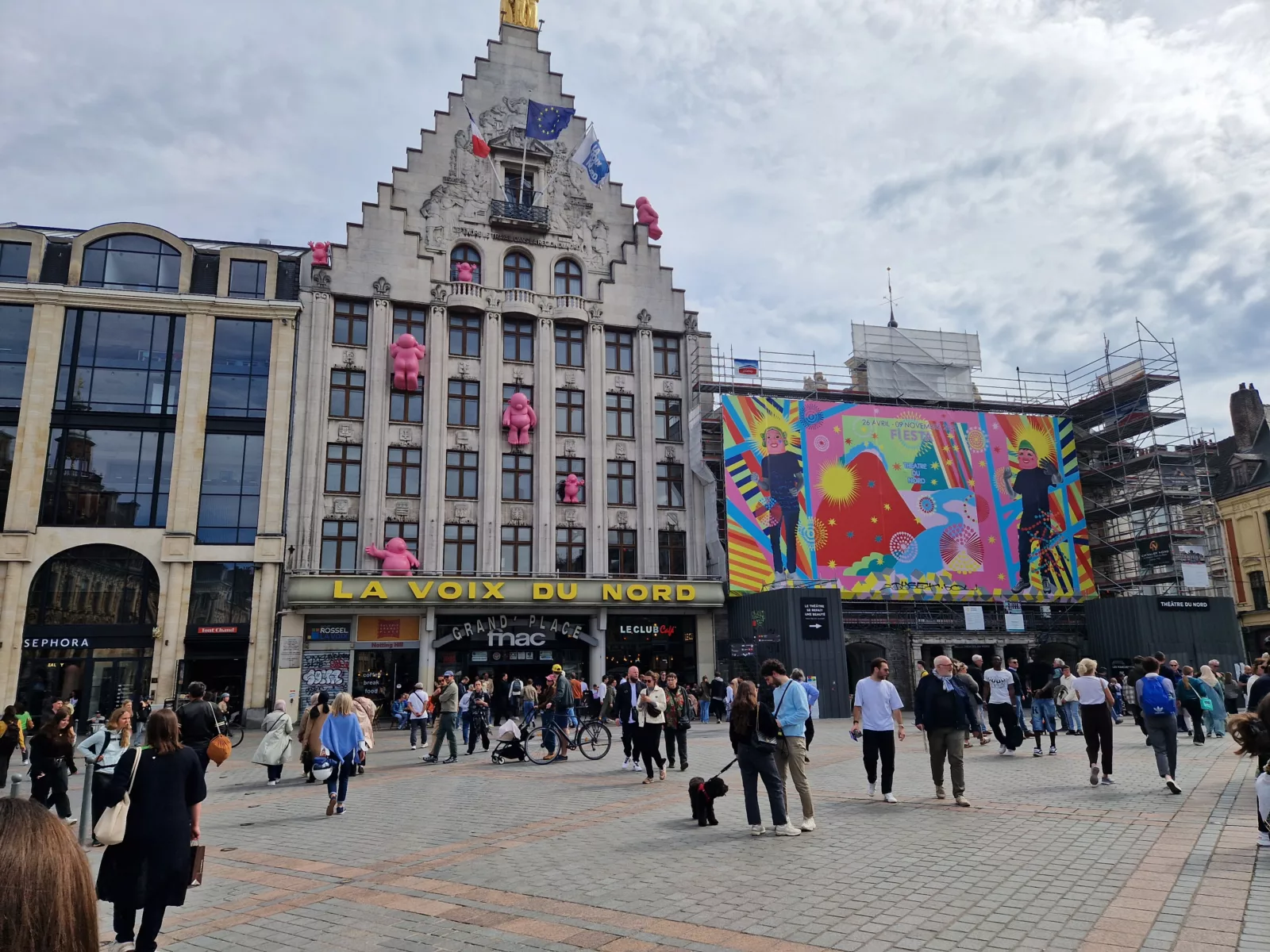
| La Voix du Nord | 1936 | Stepped gable crowned by three gilded Graces |
| Furet du Nord | Today | A huge bookshop and a classic meeting point |
The three Graces
The Voix du Nord building was designed by Albert Laprade for the Grand Écho du Nord newspaper in 1936. The three gilded figures on top, by Raymond Couvegnes, stand for the old provinces of the region: Artois holding a Newfoundland dog on the left, Flanders with a sheaf of wheat in the middle, and Hainaut releasing a carrier pigeon on the right.
The Vieille Bourse
The Bourse deserves more than a glance from the square. Step through one of its archways to find the courtyard, its booksellers and chess players. I have written a separate page on the Vieille Bourse in Lille.
When to go, and staying nearby
The square changes with the calendar, so it is worth timing your visit.
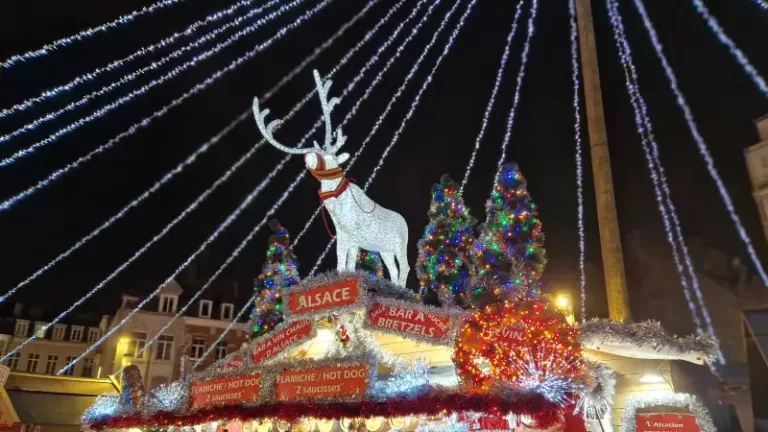
- Late November to December: the big wheel and a giant Christmas tree take over. See my guide to the Lille Christmas market.
- First weekend of September: the Braderie fills every inch of the square.
- Summer evenings: café terraces spread across the cobbles until late.
- Weekday mornings: the quietest time for photos of the façades.
The cobbles had a makeover this autumn: paving repairs ran from 7 September to 12 October 2026, so the surface is in good shape again.
Hotels around the Grand Place
Plenty of hotels put “Grand Place” in their name. Some overlook the square, others are a few streets away, so check the map before you book if a view matters to you. Rooms facing the square are lively at night, especially in December and on Braderie weekend. My guide to where to stay in Lille compares the neighbourhoods.
Getting there
Rihour metro (line 1) is two minutes’ walk away. From Lille Flandres station, walk down rue Faidherbe and you reach the square in about five minutes.
The Grand Place in Lille, square by square
The Grand Place in Lille packs four centuries into one square: a grain market turned trading hub, a goddess holding a lit fuse, a Spanish-era exchange and a 1930s newspaper building crowned in gold. It is free, open around the clock and impossible to miss. Use it as your starting point, then head north into the old town and its cobbled streets.
Frequently asked questions
What is the Grand Place in Lille called?
Its official name is Place du Général de Gaulle, given in 1944 after the Lille-born general. Locals still call it the Grand'Place, and some call it Place de la Déesse after the statue in the middle.
What is the statue in the middle of the Grand Place?
It is the Column of the Goddess, unveiled in 1845 to honour Lille's resistance to the Austrian siege of 1792. The statue is by Théophile Bra and the column by Charles Benvignat.
Which metro stop is nearest the Grand Place in Lille?
Rihour, on metro line 1, is two minutes' walk away. Lille Flandres station is about five minutes away on foot.
When is the Christmas big wheel on the Grand Place?
The big wheel goes up on the Grand Place for the Christmas season and starts turning from mid-November. Check the Christmas market dates each year for the final day.