What do La Redoute, Auchan, Decathlon, Kiabi, Pimkie and Promod have in common?
They all have roots in and around Lille, Roubaix and Tourcoing. And that’s rather extraordinary when you think about it.
This corner of Northern France gave rise to some of the country’s best-known retail businesses: mail-order catalogues, supermarkets, fashion chains, sporting goods shops and much more. Long before Amazon transformed shopping, La Redoute and its great rival, 3 Suisses, were among the pioneers who made ordering from home part of everyday life in France.
But to understand how this happened, you need to go back to the textile industry. And, in my case, to my grandfather, my father and a rather unexpected family connection to swimming pools.

From swimming pools to metres of fabric: a family story
I grew up hearing about La Redoute, Pimkie and Camaïeu long before I ever thought about writing their history. They were my father’s customers.
But the story actually begins with my grandfather. After the Second World War, he became what the French textile industry called an agent de tissage: a commercial agent representing textile manufacturers and selling their fabrics to clothing businesses.
My father, however, had other plans.
He trained as an architect and opened his own architectural practice on Rue Lepelletier, right in the heart of Old Lille. He designed houses and specialised in swimming pools, both indoor and outdoor.
He even designed the swimming pool at the Holiday Inn hotel in Marcq-en-Barœul, near the school I later attended. It was a Holiday Inn at the time; the hotel is now known as the Mercure Lille Marcq-en-Barœul.
Unfortunately, his architectural business eventually went bankrupt. He changed careers and followed in his father’s footsteps, becoming a textile sales agent.
He represented fabric manufacturers, including mills in Italy and around Lyon, and spent his days meeting buyers from major ready-to-wear retailers. Among his customers were La Redoute, Pimkie and Camaïeu.
And we’re not talking about a few metres of fabric for someone making a dress at home.
We’re talking metres and metres and metres of fabric. Then a few more metres for good measure.
This was the 1980s and 1990s, when ready-to-wear fashion needed huge quantities of material. Those famous company names were part of my childhood conversations, not just names on shop fronts.
There’s another family connection to swimming pools, incidentally. My mother learnt to swim in the magnificent municipal pool in Roubaix, now the famous La Piscine Museum of Art and Industry. My father later designed pools for a living. Perhaps swimming pools have been quietly following my family around for generations.
But let’s return to the textiles. They’re the real starting point for this retail story.
Before the shops, there were the factories
During the nineteenth century and much of the twentieth, Roubaix and Tourcoing were among France’s great textile manufacturing centres. Spinning mills, weaving factories, warehouses and garment workshops shaped the landscape and the lives of thousands of families.
The region didn’t simply sell clothes. It made fabrics and, in many cases, the clothes themselves.
Manufacturing and retailing coexisted for decades. But as competition intensified and supply chains became increasingly international, many fashion retailers sourced more fabrics and finished garments from specialist suppliers elsewhere in France and abroad.
That was the world my father worked in: the commercial network connecting fabric mills to the buyers choosing materials for fashion collections.
As local manufacturing declined, something remarkable happened. The region’s talent for selling things didn’t disappear. It flourished, first through catalogues, then through retail chains and eventually online.
1. Before Amazon, there was Roubaix
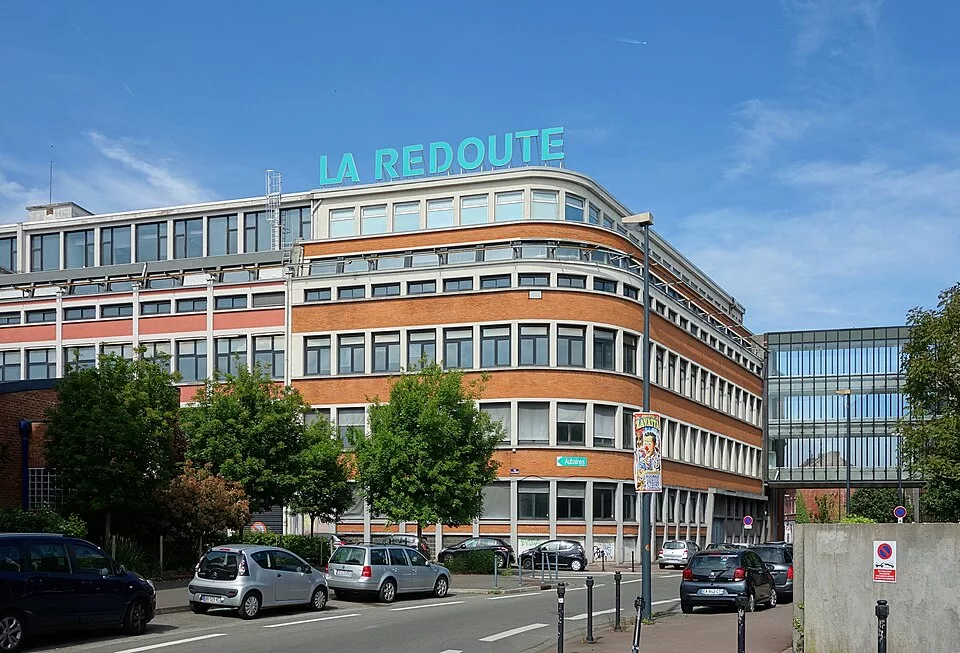
La Redoute: from a wool mill to a catalogue in every home
If you’re British, you may already know La Redoute as a French fashion and homeware retailer. Its story began in Roubaix in 1837, with Joseph Pollet’s wool-spinning business.
The family expanded its textile activities, and the business took its name from Rue de La Redoute, where it operated. Not from a glamorous designer or a branding agency. From a street in Roubaix.
In 1928, La Redoute launched a small mail-order catalogue, with knitted products offered to customers who could choose and order from home. The idea grew into something enormous.
For generations, the La Redoute catalogue was a familiar feature of French family life. It wasn’t merely a shopping tool; it was a source of fashion ideas, home inspiration and ambitious wish lists.
Long before anyone was talking about e-commerce, La Redoute had already made shopping from your living room part of the French experience. The transition from paper catalogues to online shopping was, in one sense, the next chapter of the same story.
I also went to school with a descendant of the Pollet family. For me, the names behind these companies weren’t remote historical figures. They belonged to the world I grew up around.
3 Suisses: the great rival across the Lille metropolitan area
La Redoute wasn’t alone. Its great rival, 3 Suisses, developed from the Toulemonde family’s textile business in nearby Mouvaux. Its mail-order activity took off in the 1930s, initially around knitting wool, before expanding into fashion and household goods.
For decades, La Redoute and 3 Suisses competed for a place in French homes. Their catalogues helped define a whole way of shopping: browse at home, compare, choose and order.
One particularly ingenious idea was to include small fabric samples, so customers could actually feel a material before ordering. It’s the sort of problem online fashion retailers are still trying to solve today.
So when we talk about the origins of mail-order shopping in France, the Lille area deserves a very prominent place in the story. These businesses were major pioneers, even if mail-order selling itself existed in other forms before them.
La Redoute’s history, celebrated at La Piscine in 2026
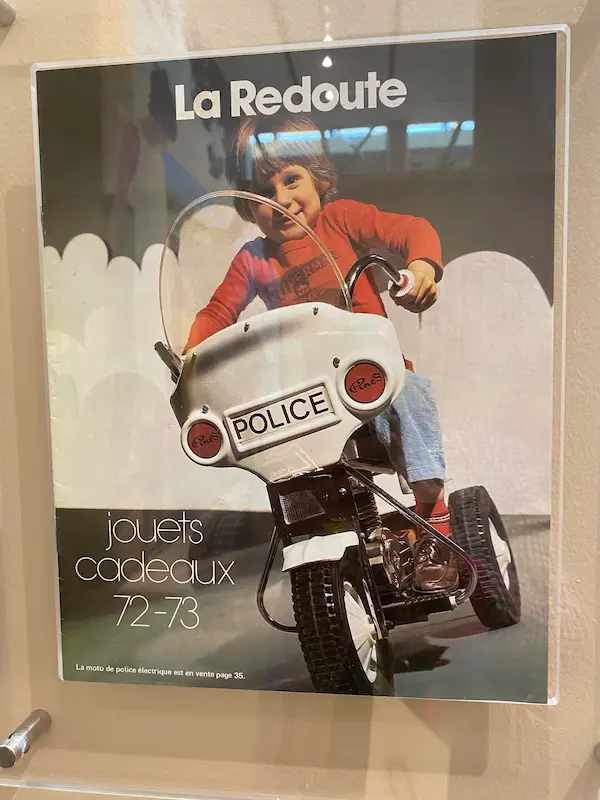
In 2026, La Piscine Museum in Roubaix devoted a major exhibition to La Redoute, exploring its fashion, design and advertising heritage. The exhibition, La Redoute, un temps d’avance. Mode, design, publicité, ran from March to July 2026.
I visited and took photographs, some of which I hope to share here. It was a wonderful way of seeing just how much one company contributed to everyday French life and to Roubaix’s identity.
And the museum itself? We’ll come back to that, because it’s one of my absolute favourite places to recommend around Lille.
2. Auchan: from a Roubaix neighbourhood to a retail empire
Here’s one of my favourite stories about Northern France’s retail history. Do you know where the name Auchan comes from?
It comes from Hauts-Champs, a neighbourhood in Roubaix. Say the names aloud and you’ll hear the connection.
In 1961, Gérard Mulliez opened his first Auchan shop in the Hauts-Champs district, in a former textile building. One of France’s most familiar retail names began with a neighbourhood in Roubaix.
Gérard Mulliez: not exactly the model schoolboy
Gérard Mulliez came from a family deeply involved in textiles, particularly through Phildar. But he wasn’t the brilliant academic success you might imagine when looking back at the founder of a retail empire.
He struggled at school and didn’t obtain his baccalauréat. One frequently told anecdote says his father promised him a motorbike if he passed. He didn’t pass, but reportedly received the motorbike anyway, as a reward for trying.
Was he something of the family’s black sheep? Perhaps that’s too strong a description, but his path was certainly unconventional.
He began working in the family textile business before turning towards a new kind of retailing. The first Auchan wasn’t an overnight success. Mulliez studied other retailers’ methods, including the ideas of Édouard Leclerc, and refined his approach to self-service shopping and low prices.
In 1967, Auchan opened a hypermarket in Roncq. The business was growing far beyond its original Roubaix neighbourhood.
The Mulliez family: much more than Auchan
The wider Mulliez family became associated with an extraordinary collection of retail businesses, from fashion and sport to automotive services and home improvement.
But an important distinction: these companies are not all subsidiaries of Auchan. Some were founded by members of the extended family, others were acquired later, and they have separate corporate histories.
One of the most famous began just outside Lille, with a few sports enthusiasts and a shopping-centre car park.
3. Decathlon: seven sports enthusiasts, a car park and an extraordinary idea
If you’ve ever bought a bicycle, walking boots or a tent from Decathlon, you might be surprised to discover where it all began.
Not in Paris. Not in the Alps. But in Englos, just outside Lille.
Michel Leclercq and the idea of all sports under one roof
Michel Leclercq, a relative of Gérard Mulliez, had worked at Auchan before deciding to launch a business of his own. His observation was simple: the new shopping centres sold practically everything, yet sports equipment was still scattered among specialist retailers.
Why not put equipment for many different sports in one large shop, with a broad selection and prices that ordinary families could afford?
Today, that sounds obvious. But good business ideas often do, once someone has had them.
Leclercq gathered a small founding team of fellow sports enthusiasts. They wanted a shop that would make it easier to discover and practise sport, not just serve people who already knew exactly what they needed.
The name Decathlon, borrowed from the ten-event athletics competition, captured that ambition to bring different sports together.
27 July 1976: the first shop opens in Englos
On 27 July 1976, the first Decathlon opened by the Auchan shopping centre in Englos.
Imagine that: a business that would become an international sporting goods giant began on the edge of a shopping-centre car park in Northern France.
Decathlon was a separate venture, however. Its family connections did not make it an Auchan subsidiary.
The first day’s takings and a pair of socks
There’s a delightful anecdote from the opening day. In one account told by an early Decathlon founder, the team counted 9,999 francs in takings.
One franc short of a satisfying round number.
So somebody bought a pair of socks.
Ten thousand francs. Much better.
It’s a wonderfully human detail in the story of a business that would eventually equip millions of people for sport. Accounts of the exact first-day figure vary, but the socks story has become part of Decathlon folklore.
When suppliers said no, Decathlon found another way
Early on, not every established sporting goods manufacturer welcomed this new retailer and its approach to pricing. Some were reluctant to supply it.
That difficulty helped push Decathlon towards a decision that would transform the company: developing products of its own.
Instead of remaining only a shop selling other manufacturers’ equipment, Decathlon began building expertise in product design and development. In 1986, it created its own production operation, an important step towards becoming both a retailer and a sporting goods designer.
In the 1990s, specialist brands such as Quechua for mountain sports and Tribord for water sports gave different activities their own identities.
The tent that made camping look easy
Then came a product that many British campers will recognise: the Quechua 2 Seconds tent, introduced in 2005.
Anyone who has wrestled with tent poles in the rain can appreciate the appeal of a tent designed to spring into shape almost instantly.
Folding it back into its bag? Well, that’s another story.
But it perfectly illustrates the Decathlon philosophy: spot an everyday problem, rethink the equipment and make the solution widely accessible.
From Englos to the world
Decathlon expanded beyond France, opening its first international shop in Germany in 1986 and growing across Europe and beyond. Its presence in Villeneuve-d’Ascq also kept the business closely connected to its Northern French origins.
In 2026, Decathlon celebrates its 50th anniversary.
Fifty years after a group of sports enthusiasts opened a shop near an Auchan car park, the company has become one of the world’s best-known names in sporting goods.
Not bad for a business whose opening-day legend involves a pair of socks.
4. Fashion made in the North: Pimkie, Kiabi, Promod and Camaïeu
If there’s one sector where Northern France’s textile heritage continued to influence retail, it’s fashion.
The region produced an extraordinary number of ready-to-wear brands. Some became familiar names across France; others expanded internationally. Several were closely connected to the world my father worked in.
Pimkie: from trousers to fashion collections
Pimkie developed in the early 1970s, initially with a focus on women’s trousers before broadening its ready-to-wear collections.
It was one of my father’s customers. When I think of Pimkie, I don’t just picture shop windows. I think of buyers choosing fabrics, manufacturers presenting collections and negotiations taking place long before a garment reached the rails.
Fashion doesn’t begin in the changing room. It begins much earlier, with materials, design, production and purchasing decisions.
Kiabi: affordable fashion for families
Founded in 1978 by Patrick Mulliez, Kiabi set out to make fashionable clothes accessible to families at affordable prices.
It was another example of the region’s ability to turn a clear, practical retail idea into a business that could grow far beyond its origins.
Promod: another Pollet family connection
Promod was founded in 1975 by Francis-Charles Pollet.
Yes, another Pollet. The same extended family name that appears in La Redoute’s story.
Promod developed its own identity in women’s fashion, another illustration of the generations of commercial expertise that emerged from the textile world.
Camaïeu: another familiar name from my childhood
Camaïeu was founded in Roubaix in 1984 and became a familiar women’s fashion chain across France.
It was also one of my father’s customers. He worked with the people responsible for choosing the fabrics that would eventually become ready-to-wear collections.
We often hear about founders and famous family fortunes, but behind every fashion collection were textile workers, mill owners, commercial agents, buyers, designers and garment producers.
Without them, there wouldn’t have been much to put on the shop rails.
Not every business survived the changes in retail. Camaïeu’s original company was liquidated in 2022, a reminder that the region’s commercial history includes difficult endings as well as spectacular successes.
5. Not just clothes: DIY, cars and electrical goods
By now, you might be wondering whether every major French retailer has some connection to Lille.
Not quite. But the list is surprisingly long.
Leroy Merlin: acquired, not founded, by the Mulliez family
Leroy Merlin’s roots are in the Pas-de-Calais, where Adolphe Leroy and Rose Merlin developed the business. The Mulliez family acquired it in 1979.
It later became a central business within ADEO, the home improvement group also associated with brands such as Weldom and Bricoman.
So Leroy Merlin wasn’t founded by the Mulliez family. It is an example of an existing business that was subsequently developed within a larger retail network.
Boulanger: electrical goods with Lille roots
Boulanger was founded in Lille in 1954 and grew from a local electrical goods business into a major French retailer of household appliances and electronics.
Electro Dépôt: a warehouse-style approach
Electro Dépôt emerged in the Lille metropolitan area in the 2000s, offering electrical goods through a deliberately simple, low-price retail model.
Norauto: another idea from Englos
Norauto was founded in 1970 by Éric Derville, with its first centre in Englos. It brought together automotive products and vehicle maintenance services.
Englos really does deserve a mention in the history of French retailing, doesn’t it?
And the wider retail family
Other brands, including Cultura, have connections to the wider Mulliez family investment network without necessarily having been founded in Lille.
That’s the distinction worth remembering: some businesses were born here; others were acquired, financed or developed by families with Northern French roots. Their histories are related, but they aren’t interchangeable.
6. What can you still see around Lille today?
All this history might sound as though it belongs in company archives. But if you’re visiting Lille, you can still see its traces in the streets, factories and remarkable buildings of Roubaix and the surrounding area.
Roubaix: the city behind the catalogues
Roubaix is the obvious place to begin. It was one of France’s great textile centres and the birthplace of La Redoute, Camaïeu and Auchan.
Walk through its former industrial districts and you’ll see factories, warehouses and workers’ housing that tell the story of the city’s manufacturing past. The Blanchemaille area is especially closely associated with La Redoute.
La Piscine in Roubaix: an absolute must-see
If you’re visiting Lille, please make the trip to Roubaix to see La Piscine, the Museum of Art and Industry.
For me, it’s one of the absolute highlights of a stay in Lille. And I don’t say that lightly.
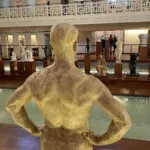
The museum occupies an extraordinary former Art Deco municipal swimming pool. The original basin is still there, with sculptures arranged around it and spectacular light streaming through the great stained-glass window at the end of the hall.
There is something almost magical about the way the architecture brings light into the building. Even on a grey Northern French day, it can feel as though the sun has found its way inside.
And there’s a personal connection. My mother learnt to swim in this very pool, long before it became a museum. My father later designed swimming pools himself, including the pool at the former Holiday Inn in Marcq-en-Barœul.
In 2026, La Piscine also hosted its major exhibition about La Redoute, bringing together the history of the city’s textile industry and its retail revolution. I went to see it and took photographs that I can share alongside this story.
But you don’t need a temporary exhibition to justify the visit. The building itself is a masterpiece.
The National Archives of the World of Work
Also in Roubaix, the Archives nationales du monde du travail occupy the former Motte-Bossut textile mill, a spectacular industrial building that looks almost like a castle.
It’s a powerful reminder of the factories and workers behind the region’s fortunes.
Villa Cavrois: a masterpiece of architecture… or a petrol station?
In nearby Croix, Villa Cavrois offers a very different glimpse into the lives of Northern France’s wealthy textile families.
Designed by Robert Mallet-Stevens for the industrialist Paul Cavrois and completed in 1932, it’s now recognised as an outstanding example of modernist architecture.
But my grandmother had her own way of describing it.
My maternal grandfather had been the Cavrois family’s doctor, so my grandmother knew the family and had seen the villa as a lived-in home, long before it became a monument open to visitors.
When she talked about its unusual architecture, she called it “a petrol station”.
Yes, really.
That was my grandmother. She had a talent for those little personal remarks that stay with you for years.
But don’t get me wrong: I think the architecture of Villa Cavrois is absolutely fabulous.
And, deep down, I suspect my grandmother appreciated it too. Perhaps “petrol station” was simply her way of joking about a building so different from the traditional grand houses of the region.
Whatever she really thought, I still smile when I look at the villa and remember her description.
It’s a remarkable place, and one I’d absolutely recommend visiting during a stay in Lille.
Lille: a trading city long before supermarkets
Finally, there’s Lille itself. Its commercial history goes back centuries before Auchan or La Redoute.
You can still see that heritage around the Grand’Place, the Vieille Bourse and the streets of Old Lille.
For more ideas, see my guide to Lille’s culture and history.
From textile mills to global retail brands
What I find most fascinating is how this region managed to reinvent itself.
First came the merchants, textile manufacturers and industrial families. Then mail-order catalogues, supermarkets, fashion chains and specialist retailers. And eventually e-commerce.
The products changed. The technology changed. Many factories disappeared. But Northern France’s commercial know-how proved remarkably resilient.
My grandfather entered the textile trade after the Second World War. My father took over the profession after an unexpected detour through architecture and swimming pools. And I grew up hearing about La Redoute, Pimkie and Camaïeu around the family table.
So when I see one of these retail names today, I don’t just see a brand. I see part of the economic and social history of the region where I grew up.
The next time you browse La Redoute online, walk into a Decathlon or pass an Auchan supermarket, remember where so much of the story began.
Not in Paris. Not in some glamorous international fashion capital.
But in the factories, offices, streets and shopping centres of Lille, Roubaix and Tourcoing.
And, in one particularly memorable case, in a car park in Englos. Not exactly somewhere I’d recommend spending your weekend, unless you fancy a trip to a huge shopping centre. Personally, I think Lille itself has far more treasures waiting to be discovered.
Keep exploring Lille’s past
- Before the retail empires, there were the textile dynasties: read about the great industrial families of Lille.
- And go further back with the surprising history of Lille, from Flemish merchants to Louis XIV.
Delphine was born and raised in the Lille metropolitan area — close enough to hear the “Mongy” tram rattle past her childhood home. After more than 20 years promoting the Nord department to British visitors, first through press trips, trade shows and tour operator partnerships, then as a digital marketing consultant specialising in tourism, she’s spent her career building bridges between her home city and the UK.
Along the way, she’s picked up a genuine soft spot for both sides of the Channel: London’s Spitalfields market and a good bagel from Brick Lane are as close to her heart as the passageways behind Lille’s cathedral or a plate of Merveilleux from her favourite bakery. She was even honoured at the British Guild of Travel Writers’ dinner at the Savoy for her work bringing Cambrai’s Tank 1917 museum to life.
On Tour de Lille, Delphine writes as the local who never left — sharing the quiet corners of her city and the stories behind them, for visitors who want to see Lille the way a Lilloise does.