I can understand why.
This morning, my British family contacted us after watching BBC News. They had seen footage from Lille showing burning bins, protesters and riot police.
Their immediate question was simple: are you safe in Lille?
It was a slightly strange question to receive, because both my partner and I had been in Lille that very morning.
And neither of us had seen anything unusual at all.
What Lille actually looked like this morning
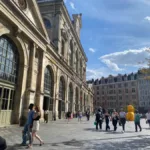
My partner Andy arrived at Lille-Flandres station at around 7.30am this morning. He teaches in Lille too and had an 8am class near the Université Catholique de Lille, in the Vauban district.
Rather than taking the metro, he walked.
That means walking for around 20 minutes from Lille-Flandres, through the city centre, past the Grand Place and across central Lille towards Vauban.
No burning streets. No chaos. No feeling of being in a city experiencing riots.
Just an ordinary early morning in Lille.
I followed a little later.
I arrived at Lille-Flandres at around 9am because, alongside running Tour de Lille and working as a digital marketing consultant, I also teach in a private business school in the Vauban area.
I walked through Lille-Flandres station, took the metro and continued to my school for my 9.30am class.
I didn’t see anything either.
Had my family in England not contacted us after watching BBC News, I would probably have had no idea that the Lille they were seeing on television looked quite so dramatic.
So, what is actually happening in Lille?
There are protests in Lille, and the pictures shown by the BBC are real.
France is currently experiencing a national movement that began with secondary-school pupils protesting over conditions in French high schools.
This distinction is worth making for British readers. When French media talk about a mouvement lycéen, they are talking primarily about pupils attending a lycée – broadly equivalent to the later years of secondary school or sixth form in the UK – rather than simply a movement of university students.
The movement has since grown, with university students, parents, teachers and trade unions also taking part in demonstrations across France.For a little more local perspective, both of my children are university students – one in Lille and the other in Valenciennes. Neither of them has been protesting, missing university because of the demonstrations, or telling me about major disruption among their friends.
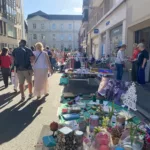
In fact, my son and his girlfriend spent most of Saturday, including the evening, at the Lille Street Food Festival. They had a perfectly normal day out and came home talking about the festival – not protests, street disturbances or problems getting around Lille. As a mother, if something significant had happened while they were out, I’m fairly sure I would have heard about it!
That’s obviously just our family’s experience, and it doesn’t mean students aren’t taking part in the movement. But again, it’s worth mentioning when the images reaching the UK can make the situation appear much more widespread than it feels in everyday life here.
Just saying.
There have also been genuine incidents. In Lille, rubbish bins have been set alight close to Lycée Faidherbe, and clashes and incidents have occurred around some of the protests.
None of that should be ignored or minimised.
But there is an important difference between saying “there have been incidents during protests in Lille” and giving the impression that “Lille is experiencing widespread riots”.
Those are two very different things.
Are there riots in Lille?
If you’ve searched for “Lille riots” after seeing pictures on British television, the important thing to understand is that the footage shows specific incidents connected with the current protests.
It does not show the normal everyday experience across the whole of Lille.
A television camera will, quite understandably, point towards the burning bins, the police and the protesters. It isn’t going to turn around and film a street 500 metres away where somebody is buying a croissant, walking to work or waiting for the metro.
And that is precisely the context that can disappear when you watch a short news report from another country.
The footage is real. It just isn’t a picture of the entire city.
Is Lille safe to visit right now?
Based on what I experienced in Lille this morning, I certainly wouldn’t cancel a trip to Lille simply because of the images currently appearing on British television.
At 7.30am, Andy walked from Lille-Flandres through the centre, past the Grand Place and towards the Université Catholique de Lille.
At 9am, I arrived at the same station, took the metro and travelled to Vauban.
We both taught our classes as planned.
Neither of us encountered any disturbance on those journeys.
That doesn’t mean a visitor should completely ignore what is happening. Demonstrations can move, roads can temporarily close and public transport can occasionally be disrupted. If you come across a protest or a police cordon, the sensible thing to do is simply to avoid it and take another route.
But that’s very different from avoiding Lille altogether.
What should tourists visiting Lille do?
If you’re travelling to Lille while demonstrations are taking place, a few simple precautions make sense:
- check local news and transport information before travelling;
- avoid streets where a demonstration or school blockade is taking place;
- don’t try to walk through a confrontation between protesters and police;
- allow a little extra time if a demonstration is scheduled along your route;
- and remember that an incident in one street does not necessarily affect the rest of the city.
For most visitors, the places they actually come to see – the Grand Place, Vieux-Lille, the shops, restaurants, museums and main tourist areas – can feel completely removed from an incident taking place elsewhere.
This morning was a perfect example.
What the BBC footage from Lille doesn’t show
This isn’t a criticism of the BBC for filming the protests.
They are newsworthy. There have been disturbances, and journalists are there to report them.
But watching a dramatic 60-second report from Britain inevitably gives you a very different perspective from walking through the city itself.
My family in England saw Lille on BBC News this morning and wondered whether we were safe.
Meanwhile, Andy had already walked across central Lille to teach his 8am class.
I arrived at Lille-Flandres at 9am, travelled across the city and started teaching at 9.30am.
Neither of us had encountered the scenes being shown on British television.
That’s why I wanted to write this.
If you’re sitting in Britain today wondering whether the pictures you’ve just seen mean you should reconsider your weekend in Lille, they need to be put into context.
Yes, there are protests.
Yes, there have been incidents.
No, those images do not mean that the whole of Lille looks like that.
Sometimes the most dramatic street in a city makes the news.
The thousands of perfectly ordinary streets around it don’t.
This article was written on 6 October 2026 and reflects the situation and our personal experience in Lille that morning. Demonstrations can evolve quickly, so visitors should check current local and transport information before travelling.
Delphine was born and raised in the Lille metropolitan area — close enough to hear the “Mongy” tram rattle past her childhood home. After more than 20 years promoting the Nord department to British visitors, first through press trips, trade shows and tour operator partnerships, then as a digital marketing consultant specialising in tourism, she’s spent her career building bridges between her home city and the UK.
Along the way, she’s picked up a genuine soft spot for both sides of the Channel: London’s Spitalfields market and a good bagel from Brick Lane are as close to her heart as the passageways behind Lille’s cathedral or a plate of Merveilleux from her favourite bakery. She was even honoured at the British Guild of Travel Writers’ dinner at the Savoy for her work bringing Cambrai’s Tank 1917 museum to life.
On Tour de Lille, Delphine writes as the local who never left — sharing the quiet corners of her city and the stories behind them, for visitors who want to see Lille the way a Lilloise does.