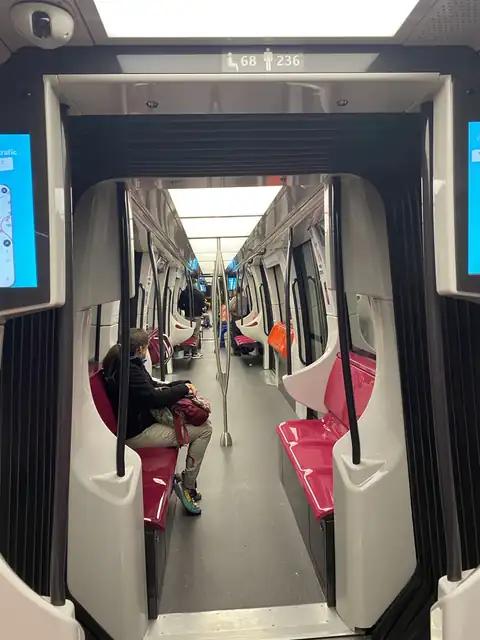
The Lille metro has carried passengers without a single driver since 1983, and under line 2 it hides a station no train has ever stopped at. Every October, the story of a passenger who stepped off there and vanished does the rounds again. Here is what is true, what was invented, and how to use the same trains to get around Lille without looking like a tourist.
I remember the opening well. I was at primary school, and my school organised a trip to go and see the brand-new metro. It was the early 1980s, rides were free during those first weeks, and half of Lille seemed to have had the same idea: we were packed in like sardines, pressed against the windows of a train with nobody at the controls. I have to admit my first ride on the Lille metro was a rather strange experience. It has come a long way since, and line 1 now runs longer trains that carry twice as many passengers.
The Lille metro: a global first born on a university campus
Most cities buy their metro from somewhere else. Lille invented its own. In 1971, Professor Robert Gabillard and his team at the science faculty of the University of Lille patented a small, fully automatic train on rubber tyres. They called it the VAL, for Véhicule Automatique Léger, and the engineering firm Matra turned the idea into real rolling stock.
On 25 April 1983, line 1 opened between Quatre Cantons and République. President François Mitterrand flew in by helicopter for the occasion, landed at Quatre Cantons and unveiled a plaque at République. Lille became the first city to run the VAL, a light metro with no driver in the cab, decades before driverless trains became a selling point elsewhere.
The network in numbers
- Line 1 runs 18 stations from CHU-Eurasanté to Quatre Cantons, through the city centre and the campus of Villeneuve d’Ascq.
- Line 2 runs 44 stations from Saint-Philibert to CH Dron, near the Belgian border, by way of Roubaix and Tourcoing.
- Together, the two lines serve 60 stations over roughly 45 km, all run by Ilévia.
Longer trains, same idea
The original VAL trains are only 26 metres long. After more than a decade of works to stretch the platforms, the first 52-metre trains on line 1 entered service on 14 February 2026, doubling capacity on the busiest line. The concept has not changed: you still stand at the front window and watch the tunnel come at you. Lille’s knack for home-grown ideas did not stop with trains, as the story of France’s biggest retail brands born in Lille shows.
The ghost station of line 2: what is really under avenue du Président Hoover
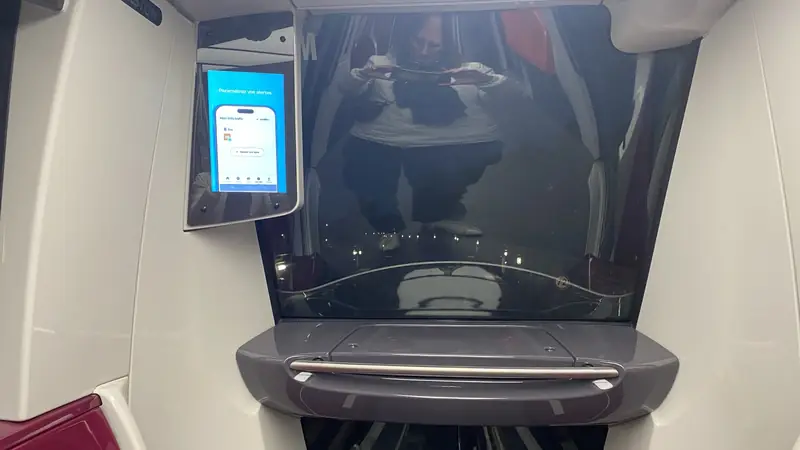
Ride line 2 between Lille Grand Palais and Porte de Valenciennes and you pass the most famous station in Lille that does not exist. It sits under avenue du Président Hoover, close to the old Saint-Sauveur goods yard, and it has never opened to a single passenger.
A station planned, then shelved
When engineers drew line 2 in the 1980s, they left a technical reserve at this spot, in case the district one day needed a stop. A metro information magazine floated a full station there in 1982, and the idea was quietly dropped. It came back during Lille’s bid for the 2004 Summer Olympics, when the Saint-Sauveur area was pencilled in for Olympic use. The bid failed, and the station went back in the drawer.
So is there a platform down there?
Accounts disagree. Some French media describe a sealed, unfinished platform in the dark. The most detailed technical record of line 2 says only the track was reinforced for a future station, with no platform built. The site appears in the control centre’s programmes and came up again in 2009, when the city debated what to do with the Saint-Sauveur brownfield.
The honest answer: a station was planned, the track is ready for one, and no passenger has ever set foot on it.
Above ground, the old Gare Saint-Sauveur is now a cultural venue with bars, exhibitions and festivals, a short walk from Mairie de Lille and Lille Grand Palais stations. If you want more of the city’s layered past, our guide to the surprising history of Lille goes back much further than the 1980s.
The legend of the vanished passenger, and who made it up
Ask a Lille student about the ghost station and you will probably get the full horror version. One winter evening, a line 2 train stops in the tunnel for no reason. A young woman steps out onto the dark platform. The doors close, the train moves on, and she is never seen again. Rescuers find only her belongings on a bench. Since then, passengers claim to hear sobbing or screams as the train passes, and a few swear they have seen a pale face in the window.
A Halloween campaign that got out of hand
The story was written by the transport operator itself. In 2015, Transpole, which has been called Ilévia since 2019, ran a Halloween campaign with fake press articles and fake witness videos on social media. Students and urbex fans shared it, the joke lost its label, and it became one of the city’s favourite urban legends. In 2023, the newspaper 20 Minutes traced the tale back to that campaign.
- True: a station was planned on line 2 and never opened.
- False: the vanished passenger, the screams and the face in the window.
- Still happening: the story resurfaces on social media every October.
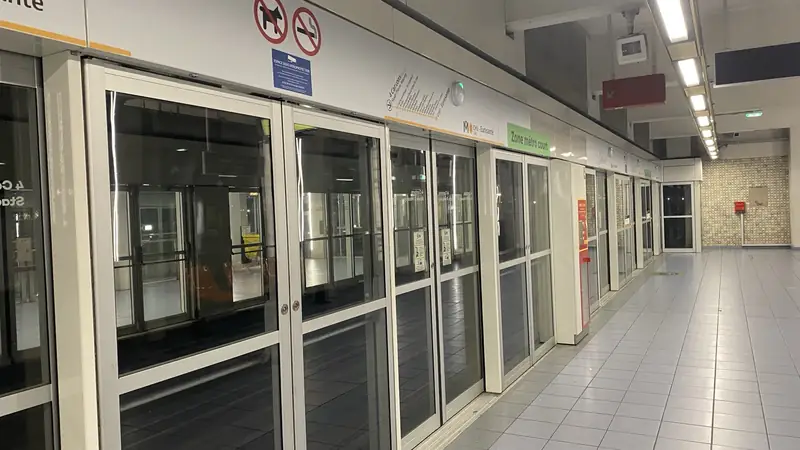
A word of warning: the doors on every Lille metro platform are screen doors, and trains do not open them in a tunnel. Nobody can step off between stations, which rather spoils the plot.
Stations worth getting off for
The Lille metro is no Moscow, but a handful of stations are worth a look on the way to somewhere else. The best one greets many British visitors the moment they step off the Eurostar.
| Station | Line | What to look for |
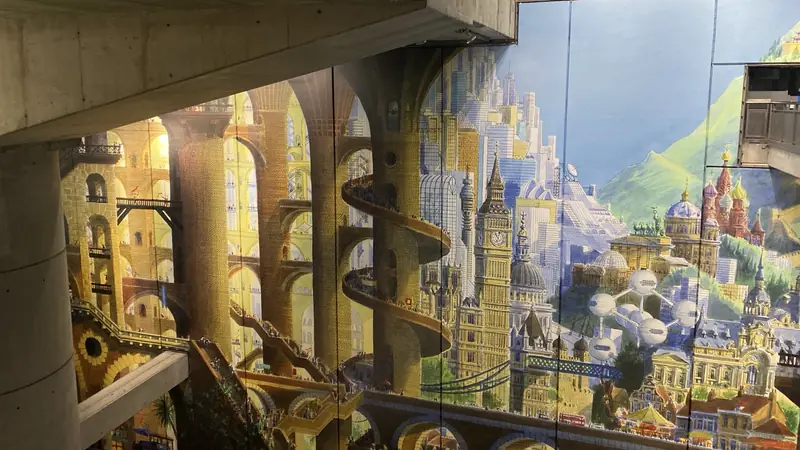
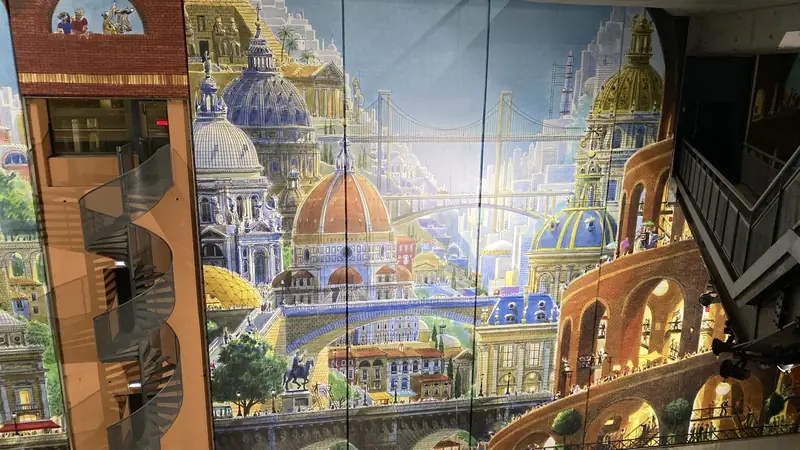
| Lille Europe | 2 | Piranèse 2000, Jean Pattou’s huge printed mural of an imaginary city mixing Big Ben, the pyramids and Lille’s Old Stock Exchange |
| Porte de Valenciennes | 2 | A giant hand sculpture by César that seems to hold up a pillar |
| Eurotéléport, Roubaix | 2 | A glass dome that pours daylight down onto the platforms |
| Croix Centre | 2 | A painted ceiling above the tracks |
| République Beaux-Arts | 1 | A huge open crater that lets daylight down to the platforms, and sculptures including Foyatier’s Spartacus breaking his chains, Carrier-Belleuse’s Autumn and Spring, and Armand Debève’s Muses hanging in the entrance hall |
| Montebello | 2 | Aquariums set into the walls since the station opened in 1989 |
| Cité Scientifique Professeur Gabillard | 1 | The station named after the man who invented the VAL |
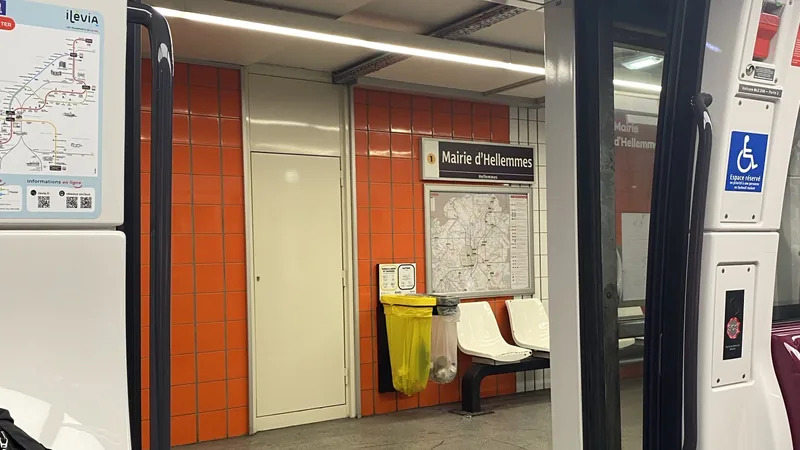
To be fair, there are also stations not worth getting off for. Mairie d’Hellemmes, on line 1, is a fine example: orange tiles, a network map, two plastic seats and a bin bag. Nobody has ever planned a day trip around it. Enjoy the view while the doors are open, then let the train carry you somewhere better.
Piranèse 2000, back from the restorers
Jean Pattou’s mural takes its name from Piranesi, the 18th-century Italian engraver of imaginary cities. After 25 years underground it had faded badly, so the Métropole Européenne de Lille had it removed, digitised and reprinted in tougher materials. It was reinaugurated on 13 June 2025. Look up as you ride the escalator.
Montebello’s aquariums, a long-running row
The aquariums at Montebello have been part of the station since it opened in 1989, and they have made plenty of headlines. Many Lillois find it cruel to keep fish underground, with no daylight and the noise and vibration of the trains all day long. In 2026, a petition asking for the fish to be moved to proper shelters gathered more than 16,000 signatures. The tanks and their water plants are still there; whether the fish stay is another story.
The tram older Lillois still call the Mongy
The metro is not the only rail line with a story. The tram along the Grand Boulevard between Lille, Roubaix and Tourcoing has been running since 1909, and people of my generation still call it the Mongy, after Alfred Mongy, the engineer behind the boulevard. Today it is simply le tram. When I was little it was red and very noisy. I grew up on the Grand Boulevard between Lille and Roubaix, and its ta-ta-ta-tam, ta-ta-ta-tam was my morning alarm. Today’s trams are much quieter, faster and safer. The line starts at Gare Lille Flandres. Between Marcq-en-Barœul and Tourcoing, and on the branch to Roubaix, keep your eyes on the window: the Grand Boulevard is lined with the villas of the business families you meet in our story of Lille’s great industrial dynasties. Most were built in the early 20th century, many in the 1920s and 1930s, and they mix every style going: Art nouveau ironwork, Art déco facades, Anglo-Norman timber gables, even curved “ocean liner” corners.
How to ride the Lille metro like a local
Coming off the Eurostar at Lille Europe, you are one stop on line 2 from Gare Lille Flandres, where you change for line 1 or the tram to Roubaix and Tourcoing. The walk between the two stations takes about ten minutes, so the metro only makes sense with luggage or rain. Our page on getting to Lille covers both stations in detail.
Tickets and prices
Ilévia raised its fares on 1 August 2026. One ticket covers the metro, the tram and the buses.
| Ticket | Price | Best for |
| Single journey | €1.90 (about £1.65) | One trip, changes allowed within the time limit |
| Single journey by SMS | €2.10 | No queue at the machine, French mobile number needed |
| 10 journeys | €16.60 | A long weekend for two |
| Day pass | €5.70 | Three trips or more in a day |
| Zap journey | €1.20 | A hop of a few stops |
Five habits Lillois have
- Buy tickets at the machines in any station, then validate at the gate every time you board, even with a day pass.
- Keep your ticket until you leave the network: inspectors do check, and the fine costs far more than the fare.
- Stand on the right of the escalators. Lille is less strict than London, but locals notice.
- Grab the front seat: with no driver, you get the cab view for the price of a ticket.
- Check the last train: the metro runs from about 5am to around midnight, and line 2 stops at the same time as line 1 on Saturday evenings.
Trams, buses, hire bikes and taxis are all in our guide to getting around Lille.
Lille metro FAQ
Is there a ghost station on the Lille metro?
Yes and no. A station was planned on line 2 between Lille Grand Palais and Porte de Valenciennes, but it never opened. The haunted passenger story is a Halloween joke from 2015.
Is the Lille metro driverless?
Yes. Both lines have run without drivers since they opened, on the VAL system invented at the University of Lille.
How much is a metro ticket in Lille?
A single journey costs €1.90 and a day pass €5.70, at the fares in force since 1 August 2026.
Does the metro go from Lille Europe to the Old Town?
Not quite. Take line 2 one stop to Gare Lille Flandres, then walk about fifteen minutes, or hop off at Rihour on line 1 for the Grand’Place.
The Lille metro: ride it for the view, not the ghost
Lille built its own driverless metro on a university campus, kept a station on line 2 in reserve for an Olympic dream that never came, then let its own transport operator turn that empty spot into a ghost story. The trains keep getting longer and the legend keeps growing. Buy a day pass, take the front seat and count how many of the city’s stories you can spot from the window.
More to see while you’re in Lille
- Curious about how the city got here? Read the surprising history of Lille, from Flemish town to French city.
- Riding the tram past grand mansions? Meet the industrial families of Lille who built them.
- Wondering which famous names started here? See the French brands born in Lille.
- First time in the city? Start with the Lille Top Ten, wander through Lille Old Town and dig into its culture and history.
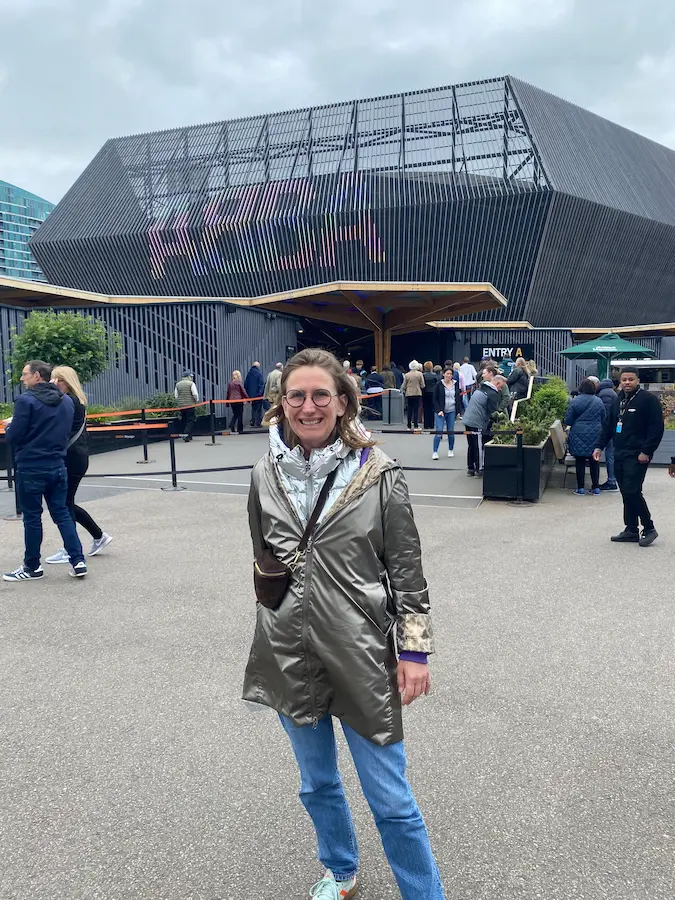
Delphine was born and raised in the Lille metropolitan area — close enough to hear the “Mongy” tram rattle past her childhood home. After more than 20 years promoting the Nord department to British visitors, first through press trips, trade shows and tour operator partnerships, then as a digital marketing consultant specialising in tourism, she’s spent her career building bridges between her home city and the UK.
Along the way, she’s picked up a genuine soft spot for both sides of the Channel: London’s Spitalfields market and a good bagel from Brick Lane are as close to her heart as the passageways behind Lille’s cathedral or a plate of Merveilleux from her favourite bakery. She was even honoured at the British Guild of Travel Writers’ dinner at the Savoy for her work bringing Cambrai’s Tank 1917 museum to life.
On Tour de Lille, Delphine writes as the local who never left — sharing the quiet corners of her city and the stories behind them, for visitors who want to see Lille the way a Lilloise does.