Lille landmarks
Porte de Paris in Lille: Louis XIV's triumphal arch that outlived its walls
A city gate, a triumphal arch and a monument to a ten-day siege
In short: the Porte de Paris is a triumphal arch built from 1685 to 1692 by Simon Vollant, to celebrate Louis XIV’s capture of Lille in 1667. It is the only city gate in France that doubles as a triumphal arch. It stands on Place Simon Vollant, by the town hall, free to see at any time.
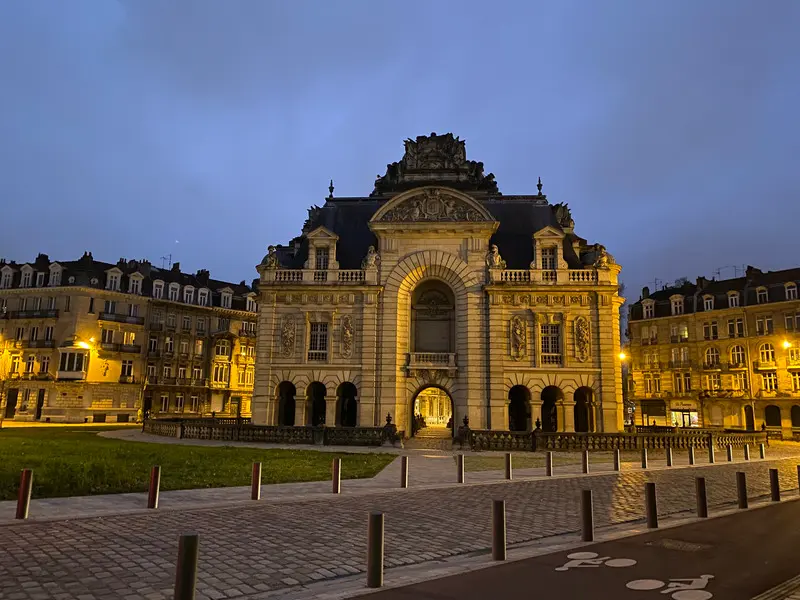
Lille’s ramparts have gone, but one of their gates is still standing in the middle of a roundabout garden, like a doorway with no house around it. The Porte de Paris is the grandest relic of the day Lille became French, and most visitors only notice it from a bus window. It deserves ten minutes on foot.
Ten days in August 1667
In the summer of 1667, Lille was a Spanish-ruled Flemish town and Louis XIV wanted it. His army besieged the city, and the town held out for ten days.
- August 1667: Louis XIV lays siege to Lille.
- 28 August 1667: after ten days, the king enters the city through the old gate on this spot and receives the keys of the city from its magistrates.
- 1668: the Treaty of Aix-la-Chapelle makes Lille officially French.
- 1685 to 1692: the old gate is rebuilt as a triumphal arch.
- 1875: the Porte de Paris is listed as a historic monument.
Before the arch, the gate had a much less glorious name: the porte des Malades, the gate of the Sick, after a hospital outside the walls. Louis XIV entered through it as a conqueror, and twenty years later the king’s men turned it into a monument to that entry.
Why the king cared
Lille was a rich trading city on the road to Flanders. Louis XIV had a citadel built here straight after the conquest, and the arch was another way of stamping French authority on the town.
Why it survived
When Lille pulled down most of its walls to expand, the arch was kept as a monument. It now sits alone, with the old ramparts gone on either side.
Simon Vollant’s arch, 1685 to 1692
The architect was Simon Vollant, a Lille engineer who had built the citadel of Lille for Vauban and became one of the king’s most trusted fortification builders.
| Fact | Detail |
|---|---|
| Architect | Simon Vollant |
| Built | 1685 to 1692 |
| Commissioned for | Louis XIV, to mark the capture of Lille in 1667 |
| Style | French classical |
| Listed | Historic monument since 1875 |
| Location | Place Simon Vollant, named after its architect |
What makes it rare is the double job. Paris has triumphal arches and many towns kept their old gates, but the Porte de Paris is the only example of a working city gate built as a triumphal arch.
Two faces: what to look for
Walk all the way round. The arch has two very different sides, because it was built to be seen from two directions.
- The outer face, which once looked out from the walls: a figure of Victory about to crown a medallion of Louis XIV.
- The warriors: statues of Mars and Hercules, the gods of war and strength.
- Fame: figures sounding the king’s victory, a nod to the pomp of Versailles.
- The inner face, towards the town hall: calmer, with arcades and a roof that make it look more like a pavilion than a gate.
Come back at dusk. When the floodlights come on, the inner face glows gold against the evening sky, and the town hall belfry rises behind you.
Getting there and what’s next door
The Porte de Paris stands on Place Simon Vollant, surrounded by a small garden with steps. Mairie de Lille metro (line 2) is two minutes away, and the walk from the Grand Place takes around 15 minutes.
- Price: free, it is a public monument.
- Opening times: open all year, day and night.
- Time needed: ten minutes, longer with a camera.
Place Simon Vollant is also the meeting point for visits to the Lille belfry, so you can see the arch while you wait for your slot. Afterwards, Gare Saint Sauveur is a short walk away for a drink or an exhibition.
Why the Porte de Paris in Lille deserves a detour
The Porte de Paris in Lille marks the moment the city became French: a ten-day siege in 1667, a king’s entry through a humble gate and a triumphal arch raised on the same spot twenty years later. It costs nothing, takes ten minutes and sits next to the belfry. For the bigger picture of how Lille changed hands, read my short history of Lille.
Where to find it
Frequently asked questions
Who built the Porte de Paris in Lille?
The architect Simon Vollant built it between 1685 and 1692, on the orders of Louis XIV. He had also built the citadel of Lille for Vauban.
Why was the Porte de Paris built?
To celebrate Louis XIV's capture of Lille in 1667. The king entered the city through the old gate on this spot after a ten-day siege.
Can you visit the Porte de Paris?
Yes, it is a free public monument on Place Simon Vollant, open all year. Mairie de Lille metro is two minutes away.
Is the Porte de Paris near the Lille belfry?
Yes. It stands in front of the town hall, and Place Simon Vollant is the meeting point for belfry visits.