Lille landmarks
Palais Rihour: the Dukes of Burgundy's palace that now houses Lille's tourist office
Five centuries, three fires and one very useful ground floor
In short: the Palais Rihour is the last trace of the Dukes of Burgundy in Lille. Philip the Good began it in 1453 and it was finished around 1473 under his son Charles the Bold. One wing survives: the guard room, now the tourist office, and the chapel upstairs. It stands by Rihour metro, two minutes from the Grand Place.
Most visitors walk into the Palais Rihour without realising it. They go in to buy a city pass or book the belfry, look up at the vaulted ceiling and wonder why the tourist office is in a church. It is not a church: it is what is left of a ducal palace that once filled the whole block.
A palace for the Dukes of Burgundy
In the 15th century, Lille belonged to the Dukes of Burgundy, among the richest rulers in Europe. Philip the Good wanted a residence worthy of his court, and the old palace in town had become too run-down.
- 1450: Philip the Good negotiates funding for a new palace with the city.
- 1453: building starts on marshy ground at Rihour.
- Around 1473: the palace is finished under Charles the Bold, Philip’s son.
- 1700 and 1756: two fires damage the building.
- 1875: what remains is listed as a historic monument.
- 1916: a third fire destroys most of the rest.
The palace later served as Lille’s town hall, until that 1916 fire. The city then built a new town hall in the Saint-Sauveur district, topped by the belfry you can climb today.
What survives, and what to look for
Only one wing escaped the fires, in late Flamboyant Gothic style. It is small, but it is the only building left from Lille’s Burgundian years.
| Part | What it is today |
|---|---|
| Salle des Gardes (guard room) | The Lille tourist office, under rib vaults |
| Salle du Conclave (former ducal chapel) | Temporary exhibitions, upstairs |
| Staircase turret | The octagonal tower with the spiral stair |
| Mullioned windows | Typical late Gothic detail on the façade |
The Salle du Conclave
Upstairs, the old chapel with its stained glass was where the city’s magistrates once made laws and held court. It now hosts exhibitions and is generally open on weekdays, from 10am to 12.30pm and 1.30pm to 5.30pm.
The war memorial
In front of the palace stands Lille’s monument to the dead of the First World War. It is so large that it hides much of the old building, which is why so many people miss the palace altogether.
Using it as your starting point
The Palais Rihour is the most practical first stop in Lille.
- Tourist office: maps, the City Pass and bookings for the belfry, the Citadel and guided tours.
- Guided walks: the tourist office runs a Vieux-Lille walk, usually every day at 3pm.
- Metro: Rihour station, line 1, is right outside.
- Price: free to walk in.
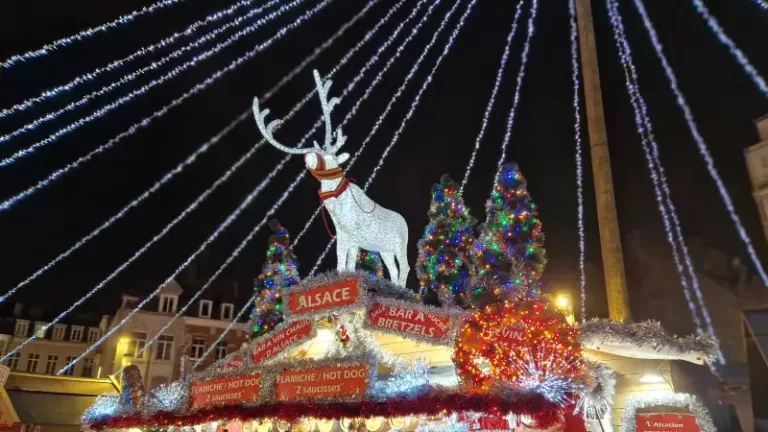
In December, Place Rihour fills with the chalets of the Christmas market, so the tourist office is right in the middle of it.
Book tours and check opening times on the Lille tourist office website.
The Palais Rihour, a palace in disguise
The Palais Rihour was begun in 1453 for Philip the Good, survived three fires and served as the town hall before becoming the tourist office. What is left is small, but it is the only witness of Burgundian Lille. Pop in for your maps, look up at the vaults, then walk two minutes to the Grand Place.
Frequently asked questions
What is the Palais Rihour?
It is the surviving wing of the palace of the Dukes of Burgundy in Lille, begun in 1453 by Philip the Good. It now houses the Lille tourist office.
Can you visit the Palais Rihour?
Yes, it is free to walk in. The ground floor is the tourist office, and the old chapel upstairs, the Salle du Conclave, hosts exhibitions on weekdays.
Where is the Lille tourist office?
In the Palais Rihour, on Place Rihour, next to Rihour metro station and two minutes from the Grand Place.
What is the monument in front of the Palais Rihour?
Lille's memorial to the dead of the First World War, which stands in front of the palace and hides part of it.