Driving from London to Lille in an electric car sounds like the sort of journey that requires spreadsheets, three charging apps and a mild obsession with battery percentages.
It doesn’t.
I made the journey in a Peugeot e-208, a small EV with a real motorway range of around 200 km in the conditions I experienced. I left London with 94% battery, stopped once to charge in Kent, took the ferry from Dover to Calais and then drove straight on to Lille.
I also did the journey in the opposite direction. Leaving Lille with a full battery, I reached Calais with 50% remaining, charged on board the P&O Pioneer and made it all the way from Dover to London without stopping again.
So, is an electric car a realistic way to travel from London to Lille? Absolutely. The more interesting question is actually what you do with the car once you get here.
If you’re still deciding between Eurostar, ferry, LeShuttle, coach and driving, start with my complete guide to getting to Lille from the UK. This article is specifically about what the journey is like when you decide to bring your own electric car.
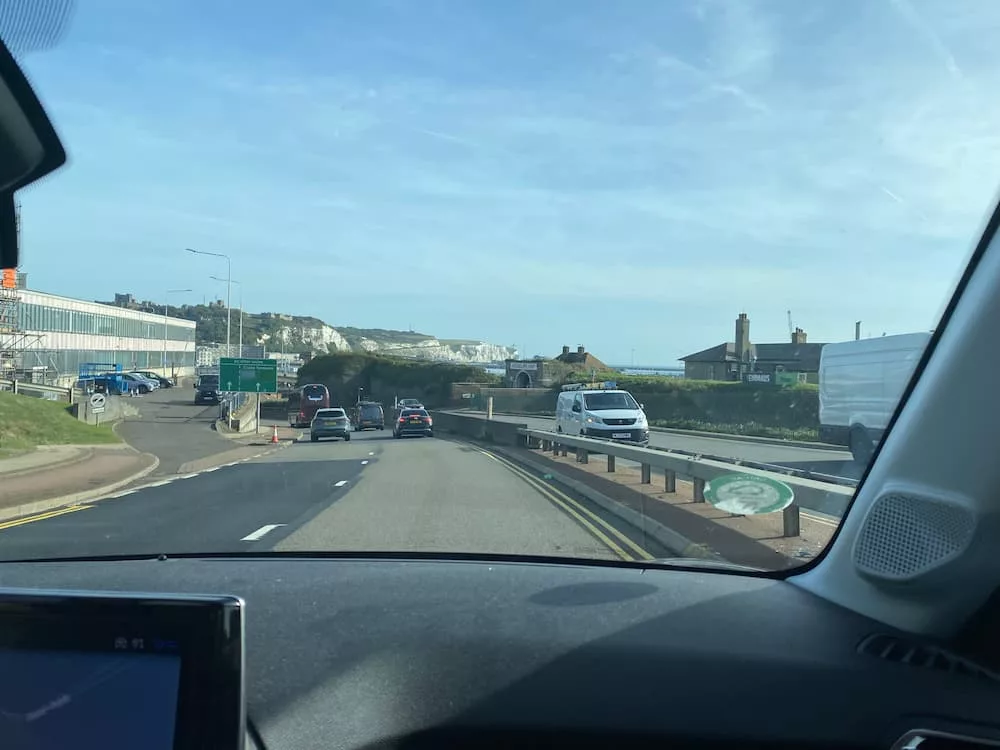
London to Lille in a Peugeot e-208: the journey
Let’s start with the car, because I didn’t exactly choose an EV with an enormous touring range.
Peugeot’s official figures for the e-208 are considerably higher, but on motorway journeys I work on roughly 200 km of real-world range. Motorway speeds, weather, heating and driving conditions all make a difference, so I would rather plan around what I actually see on the dashboard than a laboratory figure.
I left London with 94% battery and headed south-east towards Kent.
The distance itself isn’t the difficult part of this journey. What matters with a relatively small EV is deciding where it makes sense to charge before crossing the Channel.
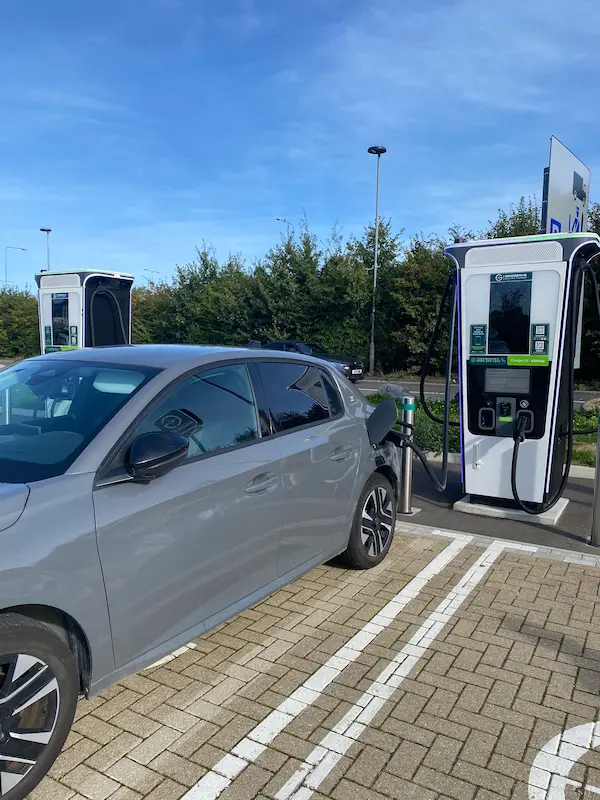
My charging stop at Folkestone
I stopped at the GRIDSERVE chargers at Folkestone Services on the M20, close to the Channel crossing.
This is a particularly useful place to stop because you’re almost at the end of the UK section of the journey. Rather than arriving at Dover worrying about how much charge you’ll have left once you reach France, you can top up here and cross the Channel with a comfortable margin.
I used my Chargemap Pass to charge. I use Chargemap when travelling because it saves me from having to download a different app every time I encounter another charging network.
I left Folkestone with around 84% battery, more than enough for the next part of the journey.
Dover to Calais with an electric car
From Folkestone, it’s a short run to the Port of Dover and the ferry to Calais.
You can of course take LeShuttle instead. I cover both options in my UK to Lille transport guide, but I rather like the ferry when I’m driving.
After the motorway, you get a proper break. Park the car, go upstairs, have something to eat, get some fresh air and let somebody else do the travelling for a while.
There is another advantage for EV drivers that I discovered on this trip: some P&O ferries can charge your car while you cross the Channel.
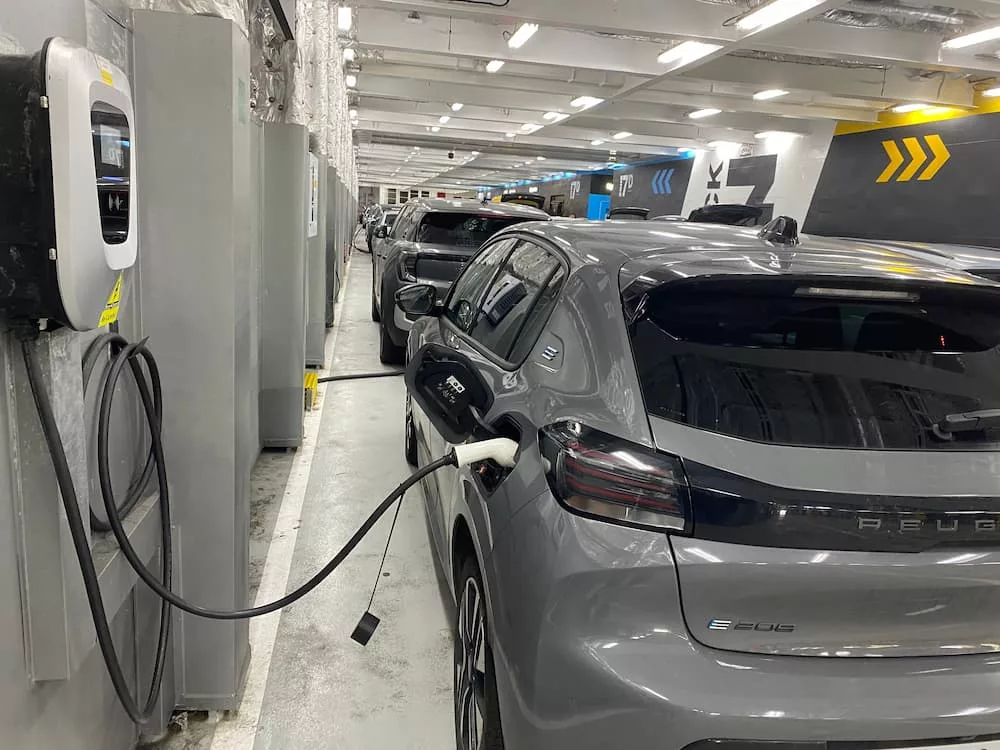
Yes, you can charge an electric car on some P&O ferries
P&O currently offers EV charging on two ships operating between Dover and Calais: P&O Pioneer and P&O Liberté.
I used it on the Pioneer on my journey in the other direction, from Lille back to London.
On that trip, I left Lille with 100% battery. By the time I reached Calais, the e-208 was at around 50%.
Once on board the Pioneer, I asked the crew about charging and plugged in on the car deck. During the crossing, the battery went from 50% to 84%.
That 84% was enough for me to drive from Dover all the way back to London without another charging stop.
For a small EV with around 200 km of motorway range, I thought that was pretty impressive.
There is an important catch, though. Don’t build your entire journey around charging on the ferry. P&O does not guarantee a charging space and not every ship has chargers. Think of onboard charging as a very useful bonus rather than your only plan.
Calais to Lille: the easy bit
Once you drive off the ferry in Calais, the journey becomes very straightforward.
The quickest route follows the A16 and then the A25 to Lille. It’s around 110 km and normally takes about 1 hour 15 minutes. Better still for British drivers discovering French autoroutes for the first time: there are no tolls on this route.
With a decent charge when you leave Calais, even a relatively small electric car should make this section comfortably.
And that’s one of the reasons Lille works so well for a first European road trip from Britain. You’re not stepping off the ferry and facing another four or five hours behind the wheel. Lille is close enough to Calais to make the whole journey manageable.
Before driving into Lille: order your Crit’Air sticker
This is the bit British drivers shouldn’t ignore.
The Lille metropolitan area has a Low Emission Zone, or ZFE, covering all 95 municipalities of the Métropole Européenne de Lille. Vehicles travelling or parking within it need to display the appropriate Crit’Air sticker.
That includes foreign-registered cars.
An electric car receives a green Crit’Air 0 sticker, but being electric doesn’t mean you can simply drive around without one. Order the sticker before travelling and attach it to your windscreen.
Important: use the official French government Crit’Air website. There are plenty of commercial websites offering to do the same thing while charging considerably more.
You’ve arrived in Lille. Now what do you do with the car?
This, for me, is the more interesting part of the story.
You’ve driven your electric car all the way from London, successfully negotiated the ferry and reached Lille.
And now you probably don’t need it.
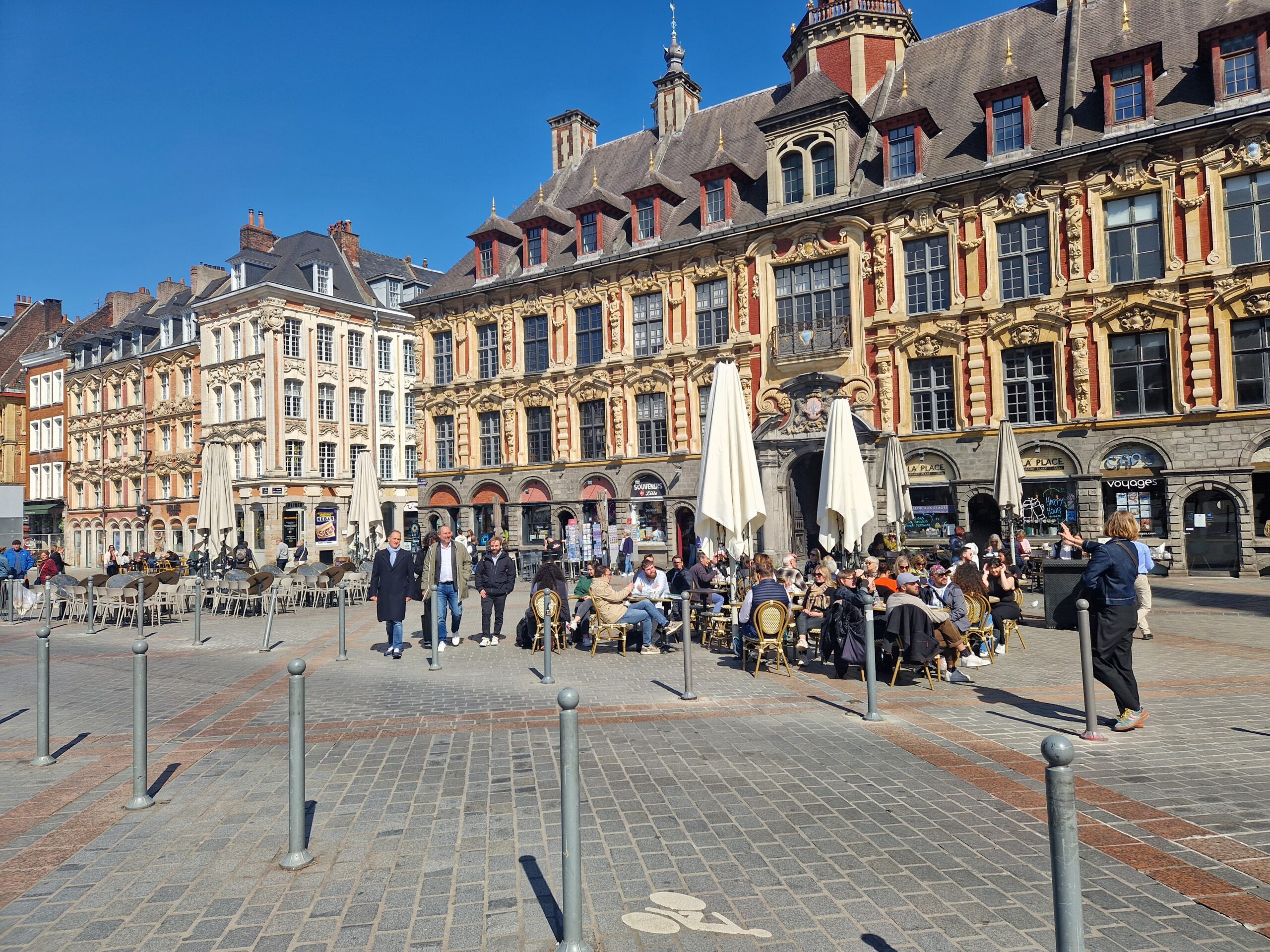
Central Lille is surprisingly compact. The Grand’Place, Place du Théâtre, the Vieille Bourse, Vieux-Lille, Lille-Flandres, the Palais des Beaux-Arts and most of the places first-time visitors want to see are easily reached on foot.
The Grand’Place itself has been pedestrianised since January 2026, and large parts of central Lille are much more pleasant explored without a car.
There are also two metro lines, two tram lines and a large bus network. Have a look at my guide to getting around Lille before deciding you need to drive everywhere.
My advice? Once you’re in central Lille, park the car and forget about it.
Where can you park cheaply outside central Lille?
If your hotel doesn’t have parking, one option is to use Lille’s Park & Ride network, known as P+R, and continue into the centre by public transport.
The parking itself doesn’t carry an additional charge when you’re using the Ilévia public transport network. You validate your transport ticket and use it to exit the car park.
Two useful options are:
- Porte des Postes – south of central Lille, with both Metro Line 1 and Line 2. The car park is open 24/7.
- Saint-Philibert – west of Lille, with public transport connections into the city and EV charging spaces available at the P+R.
If you need to charge while you’re parked, Ilévia also lists EV charging spaces at 4 Cantons, another useful P+R on Metro Line 1.
These are designed as park-and-ride facilities rather than cheap long-term storage, so check the current Ilévia conditions and opening arrangements before leaving your car.
Parking in Lille city centre can get expensive
You can drive into central Lille, of course, and there are several underground car parks around Grand’Place, Vieux-Lille, Euralille and Lille-Flandres.
But if you’re leaving the car for a long period, check the price first.
Street parking in Lille is divided into different tariff zones and much of the city is now paid parking. For a full day, the total can quickly make a hotel car park, underground car park or P+R look much more attractive.
One small tip from experience: use a parking app rather than automatically paying for a huge block of time at once.
I use EasyPark and tend to extend the parking as I need it. Lille also accepts other approved mobile payment apps. It makes it much easier to manage your time without walking back to the car every time you decide to stay for another coffee.
And in Lille, another coffee has a habit of happening.

When having a car in Lille is actually useful
So why bother bringing the car at all?
Because Lille city centre and the wider Lille metropolitan area are two different things.
Once you want to explore beyond the centre, having your own car suddenly becomes much more useful.
LaM in Villeneuve-d’Ascq
LaM – Lille Métropole Musée d’art moderne, d’art contemporain et d’art brut – is one of the major museums in the Lille area.
You can reach it by public transport, but if you don’t know the network, the metro-plus-bus journey isn’t always the most intuitive introduction to suburban Lille.
With a car, it’s straightforward.
If museums are part of your reason for visiting, have a look at my guide to culture and history in and around Lille. LaM is only one of several excellent museums outside the immediate city centre.
Villa Cavrois in Croix
Villa Cavrois is another very good example.
This extraordinary modernist house by Robert Mallet-Stevens sits in Croix, between Lille and Roubaix. You can reach the area by tram, so a car certainly isn’t essential.
But there’s still a walk to the villa, including the climb up Avenue Kennedy. If you’ve already spent the morning walking around Lille, or you’re travelling with somebody who finds hills tiring, driving is simply easier.
Roubaix and La Piscine
Roubaix is different again.
If you’re only going to visit La Piscine museum, public transport works very well and I wouldn’t take the car just for that. Roubaix is connected to Lille by metro.
But if you want to combine LaM + Villa Cavrois + La Piscine in the same day, having a car makes much more sense. Instead of repeatedly heading back towards Lille and changing between public transport services, you can make a simple circuit through the metropolitan area.
You’ll find La Piscine, LaM and Villa Cavrois among the places I recommend in my Lille Top Ten and culture guide.
A car also opens up day trips from Lille
This is where I’d really start to consider driving from Britain rather than taking Eurostar.
Lille itself doesn’t require a car. But Lille is an excellent base for exploring northern France.
Louvre-Lens, the WW1 sites around Vimy and Notre-Dame-de-Lorette, the Opal Coast, Saint-Omer and smaller towns and villages around Flanders suddenly become much easier when you aren’t planning your day around train timetables.
If you’re coming for two nights and only want Vieux-Lille, restaurants, museums and shopping, bringing a car is arguably more hassle than it’s worth.
If you’re coming for four or five days and want to explore the region, that’s a completely different calculation.
My London to Lille EV journey at a glance
| Stage | What I did |
|---|---|
| Car | Peugeot e-208 |
| Real motorway range I plan around | Approximately 200 km |
| Leaving London | 94% battery |
| UK charging stop | GRIDSERVE, Folkestone Services |
| Charging method | Chargemap Pass |
| Battery after UK charging stop | 84% |
| Channel crossing | Dover to Calais with P&O Ferries |
| Calais to Lille | A16 + A25, around 110 km, no tolls |
| Return: leaving Lille | 100% battery |
| Return: arriving in Calais | 50% battery |
| Return ferry | P&O Pioneer |
| Battery after charging on the ferry | 84% |
| Dover to London | No additional charging stop needed |
One advantage of having a boot: stop in Calais on the way home
There is one final advantage to bringing the car that has nothing to do with battery range.
You have a boot.
If you’re returning to Britain through Calais, it’s easy to leave Lille a little earlier and stop for French wine, beer or food before boarding your ferry or LeShuttle.
I’ve already put together a guide to wine and duty-free shopping in Calais if you’re planning to do exactly that.
Just remember that post-Brexit personal allowances apply when bringing alcohol back into Great Britain.
So, should you drive from London to Lille in an electric car?
After doing the journey myself in a Peugeot e-208, I wouldn’t hesitate to do it again.
What surprised me wasn’t simply that the electric car could make the journey. I expected that. It was how little range anxiety I actually experienced.
I left London with 94%, topped up at Folkestone and had plenty of battery for France. Going the other way, I left Lille at 100%, reached Calais at 50%, charged to 84% aboard the P&O Pioneer and reached London without stopping again.
That’s in a small electric car with a motorway range of around 200 km, not a long-range luxury EV.
But here’s the paradox: driving to Lille can be very useful; driving around Lille often isn’t.
For a weekend in the city centre, park the car. Lille is compact, walkable and well served by public transport.
For LaM, Villa Cavrois, Roubaix and especially trips further into northern France, having your own car gives you much more freedom.
So if you’re wondering whether an electric car can get you comfortably from London to Lille, my experience says yes.
Just don’t expect to need it when you’re sitting on a terrace five minutes from the Grand’Place.
Delphine was born and raised in the Lille metropolitan area — close enough to hear the “Mongy” tram rattle past her childhood home. After more than 20 years promoting the Nord department to British visitors, first through press trips, trade shows and tour operator partnerships, then as a digital marketing consultant specialising in tourism, she’s spent her career building bridges between her home city and the UK.
Along the way, she’s picked up a genuine soft spot for both sides of the Channel: London’s Spitalfields market and a good bagel from Brick Lane are as close to her heart as the passageways behind Lille’s cathedral or a plate of Merveilleux from her favourite bakery. She was even honoured at the British Guild of Travel Writers’ dinner at the Savoy for her work bringing Cambrai’s Tank 1917 museum to life.
On Tour de Lille, Delphine writes as the local who never left — sharing the quiet corners of her city and the stories behind them, for visitors who want to see Lille the way a Lilloise does.