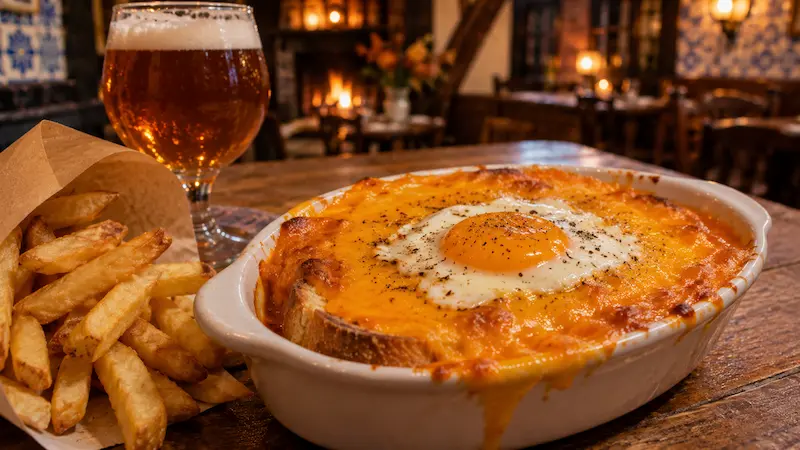
Order a welsh in Lille and you will not get a slice of cheese on toast. You will get an oven dish of molten cheddar and beer, poured over bread, mustard and ham, often crowned with a fried egg and flanked by a mountain of chips. It is the city’s comfort food, it has its own festival in November, and it barely resembles the rarebit you grew up with. Here is what to expect, how to order it and where to find the best one.
What is a welsh, and why does Lille claim it?
A welsh, pronounced much as in English, is a slice of country bread spread with mustard, topped with ham, drowned in a sauce of melted cheddar and beer, then baked until the top bubbles and browns. Most kitchens add an egg. Chips come on the side, always.
It is a meal, not a snack. Home recipes count close to 200 g of mature cheddar per person, plus a good splash of beer, which tells you all you need to know about the portion.
A British name with a French address
The name comes straight from Britain. “Welsh rabbit” first appears in English in 1725, and Hannah Glasse prints a Welsh rabbit recipe in The Art of Cookery in 1747. The spelling “rarebit” turns up later, in 1781. No rabbit has ever been harmed in the process.
How the dish crossed the Channel is less clear. A popular story credits Welsh soldiers at the siege of Boulogne in 1544, but no reliable source backs it up. What is certain is that the welsh took root along the Côte d’Opale and across the old Nord-Pas-de-Calais, where cheddar, beer and bread were never in short supply.
From the coast to the estaminet
In Lille, the welsh became a fixture of the estaminet, the Flemish-style tavern with low ceilings, wooden tables and a beer list longer than the wine list. Today you find it everywhere, from tabac bars to smart bistros, and locals argue about it the way Londoners argue about the best curry house.
Rarebit or welsh? What changes on the plate
If you know Welsh rarebit, or its egg-topped cousin the buck rarebit, you know the idea. The Lille version simply turns the volume up. Here is how the two compare.
| British Welsh rarebit | The welsh in Lille | |
| Format | Cheese sauce on toast, grilled | Bread, ham and cheese sauce baked in an oven dish |
| Cheese | Cheddar, often with Worcestershire sauce | Cheddar, sometimes maroilles or a local cheese |
| Quantity | A light lunch or supper | A full meal, often more than you can finish |
| Egg | Optional, then called a buck rarebit | Usually included |
| Eaten with | Your fingers, or a knife and fork | A knife, a fork and patience |
| Served with | Nothing much | Chips, and a beer |
How to order a welsh
Menus in Lille list the welsh under its own name, so you will not need much French. These words help:
- Welsh traditionnel: the classic, with ham and cheddar.
- Avec œuf: with an egg on top, if it is not included already.
- Au maroilles: made with maroilles, the strong local cheese. Not for beginners.
- Végétarien: without ham, often with mushrooms or vegetables instead.
- Frites maison: homemade chips, a sign the kitchen takes it seriously.
Prices in Lille estaminets usually sit around €14 to €17 for a welsh with chips, roughly the price of a pub main in a British city.
What to drink with it
Beer, without question. Many kitchens make the sauce with a blonde or amber beer, and ordering the same one in your glass is the safe choice. A lighter blonde cuts through the cheese; an amber beer brings out its sweetness. Wine drinkers are tolerated, but they will get a look.
In Lille, a welsh comes with chips and a beer. Asking for a salad instead is allowed, but nobody will understand why.
Where to eat the best welsh in Lille
Every Lillois has a favourite, and every favourite has its critics. These addresses come up again and again in local polls and food guides, and they cover the main neighbourhoods visitors stay in.
The institution: Au Georges V
Au Georges V, a former tabac bar at 104b boulevard de la Liberté, calls itself the temple of the welsh and has won Lille Addict’s readers’ poll for best welsh every year since 2019. It also serves a smoked version and a vegetarian one. The room is lively and fills up fast, so book online or by phone.
- Open: Monday to Saturday, lunch and dinner. Closed on Sundays.
- Sunday option: its quieter sister, Georgette, at 13 rue Saint-André in Vieux-Lille, serves Sunday lunch.
Vieux-Lille and the centre
The old town packs several reliable welsh addresses into a few cobbled streets, which makes it easy to fit one into a day of sightseeing.
| Address | Where | Why go |
| La Petite Table | 59 rue de la Monnaie, Vieux-Lille | A classic estaminet, light sauce, homemade chips. Closed on Mondays. |
| Le Barbier qui fume | Rue de la Monnaie and Place Rihour | A welsh with smoked ham, served all day at the Rihour branch. |
| Chtite Brigitte | 10 rue des Bouchers, Vieux-Lille | Made with sablé de Wissant, a beer-washed cheese from the coast. Vegetarian version available. |
| A Taaable | 62 rue de Gand, Vieux-Lille | Regional cooking, mustard-spread country bread, homemade mayonnaise. |
| L’Ilot Bar | 253 rue Nationale, centre | Good value, generous on the mustard, served with caper mayonnaise. |
Rue de Gand is lined with restaurants, so it is a good street to wander if your first choice is full.
Worth the trip: La Brocantine in Cysoing
La Brocantine, at 266 rue Roger Salengro in Cysoing, about 20 minutes south-east of Lille by car, is a canteen inside a second-hand shop. You eat among the antiques, and its welsh has a loyal following. It opens on Friday and Saturday evenings and for Sunday lunch only, so plan ahead.
Welsh Fest at Gare Saint-Sauveur
Lille takes its welsh seriously enough to throw it a festival. Welsh Fest, run by the AAAW (the friendly association of welsh lovers founded by the owner of Au Georges V), has taken place every November since 2023 and drew around 11,000 visitors in 2025.
Welsh Fest 2026: dates and programme
The 2026 edition runs from Friday 20 to Sunday 22 November at Gare Saint-Sauveur, a former goods station turned cultural venue at 17 boulevard Jean-Baptiste Lebas. Entry is free on all three days and there are no tickets. You pay for food and drink on site.
- Friday 20 November: doors open at 17:00, then a team relay contest, a welsh quiz hosted by Julien Lepers, a French game-show legend, and a retro party until 00:30.
- Saturday 21 November: the junior and amateur contests during the day, a guest fondue, then concerts from 20:00, with food served until 01:00.
- Sunday 22 November: the professional contest, open to chefs from France and abroad, a welsh brunch at 11:00 and the trophy ceremony at 17:30, before closing at 18:30.
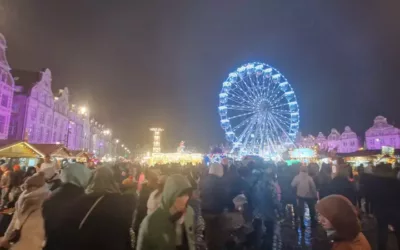
Ten restaurateurs serve welsh all weekend, alongside street food stands and friteries. Around 20 concerts, a “Noëlsh” Christmas market and the Welsh Olympics, where towns such as Lille, Calais, Boulogne, Dunkirk and Arras compete, fill the rest of the hall.
Getting to Gare Saint-Sauveur
- By metro: line 2 to Mairie de Lille or Lille Grand Palais, then a short walk.
- On foot: about 15 minutes from Lille-Flandres station, so easy from the Eurostar at Lille-Europe too.
- By bike: V’Lille stations on boulevard Louis-XIV and boulevard Jean-Baptiste Lebas.
Full timings and line-ups appear on the official Welsh Fest website, festivalduwelsh.fr, and change close to the date. The Christmas village on Place Rihour opens on 18 November, so a Welsh Fest weekend doubles as an early festive break.
Tips before you order your first welsh
- Go at lunchtime: a welsh is heavy. Eaten at noon, it leaves time to walk it off before dinner, or to skip dinner altogether.
- Book at weekends: the best-known addresses fill up on Friday and Saturday nights, especially in November and December.
- Think about sharing: one welsh with extra chips can feed two light eaters. Ask politely, and check first.
- Vegetarians are covered: most estaminets now make a version without ham.
- Check the cheese: “au maroilles” means a much stronger flavour than cheddar. Order it on purpose, not by accident.
Welsh fans have already passed the test. When Wales beat Belgium 3-1 in the Euro 2016 quarter-final at Stade Pierre-Mauroy, on 1 July 2016, plenty of red shirts ended the night in Lille estaminets, face to face with a welsh. The verdict from Cardiff is still pending.
Welsh in Lille: your questions answered
Is a Lille welsh the same as Welsh rarebit?
No. Both use melted cheese and beer, but the Lille welsh adds ham, usually an egg and chips, and comes baked in an oven dish. It is a full meal rather than cheese on toast.
How much does a welsh cost in Lille?
Expect around €14 to €17 for a welsh with chips in an estaminet. Drinks are extra.
Can vegetarians eat a welsh?
Yes. Au Georges V, Chtite Brigitte and many estaminets serve a version without ham. Ask for “un welsh végétarien”.
Where is the best welsh in Lille?
Au Georges V wins the local readers’ poll year after year, while La Petite Table and Chtite Brigitte are firm favourites in Vieux-Lille. The real answer depends on how much cheese you can handle.
When is Welsh Fest in Lille?
Welsh Fest takes place every November at Gare Saint-Sauveur. In 2026, it runs from 20 to 22 November, with free entry.
Welsh in Lille: order it once, then pick your side
The welsh borrowed its name and its cheddar from Britain and its beer from Flanders, then became the dish Lillois defend with the most passion. Try the classic at an estaminet, test a maroilles version if you are brave, and time your trip for Welsh Fest in late November if you want the whole city’s opinion on a plate. Then decide whether Wales would recognise it.
More to see while you’re in Lille
- Still hungry? Discover what to eat in Lille, from carbonnade to potjevleesch.
- Prefer something on the go? Try our guide to street food in Lille.
- Need a seat in the sun after all that cheese? Pick one of the best terraces in Lille.
- Shopping for cheese to take home? See our guide to Lille market days.
- First time in the city? Start with the Lille Top Ten, wander through Lille Old Town and dig into its culture and history.

Andy Sutcliffe is a British cycling journalist and former Editor-in-Chief of Cycling Weekly, where he also launched Cycle Sport and Mountain Bike Rider magazines. He later founded Cabal Communications, launching titles including Procycling. After decades covering the world’s biggest races from team cars, helicopters and press centres, Andy now lives in Templeuve-en-Pévèle, just south of Lille, where he teaches English and works in marketing for local businesses. He created Tour de Lille to help visitors make the most of their trip to the city and region he now calls home.